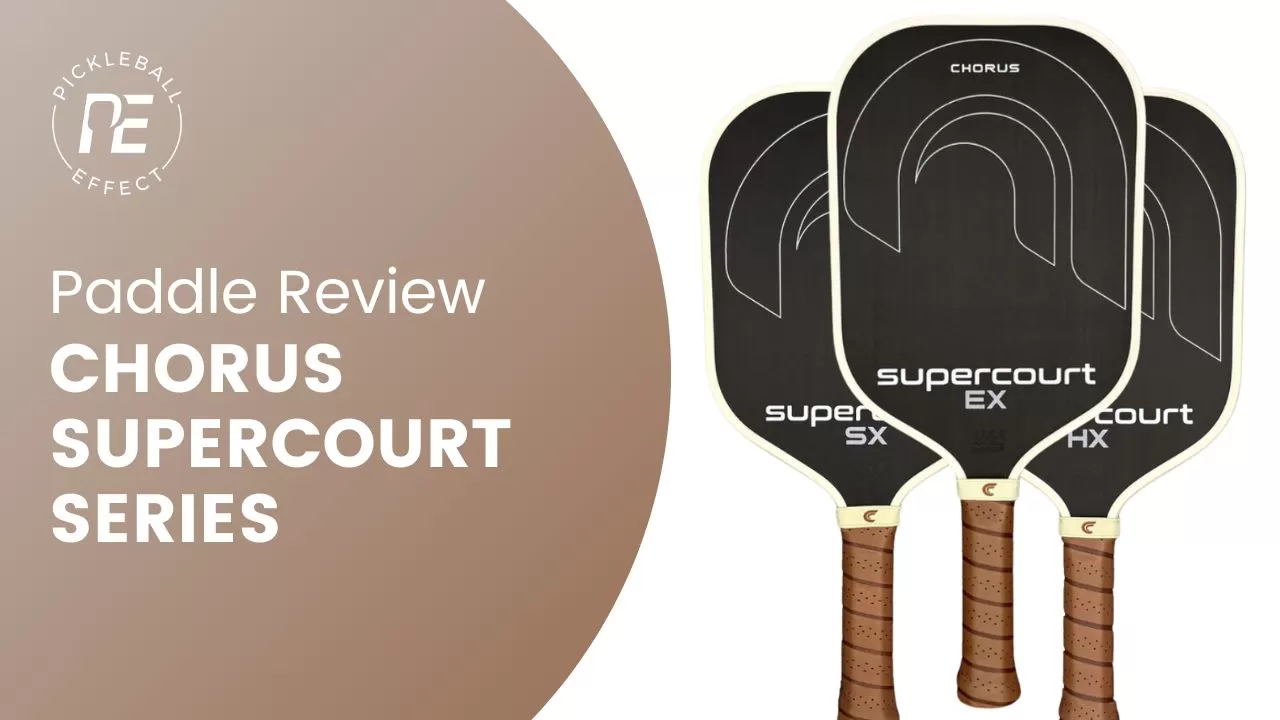
Chorus Supercourt Series Review | Includes EX, HX, and SX Models

You don’t need to spend a small fortune to get a high performing paddle. These lightweight, yet forgiving paddles offer ample power and pop for all-court play. They are affordably priced at $119, or $108 with the code PBEFFECT, and come in three different shape options, a rarity at this price point. The main drawback is their stiffer feel, which may not suit all players.

I would like to thank Chorus for sending me these paddles; however, this article is not sponsored by them. The opinions expressed here are solely my own and are intended to help you find the best paddle for your game.

For this review I’ll speak to the paddle construction, the general performance of the series, and then give a breakdown of each shape option available. Let’s dive in.

(Get 10% off with the discount code PBEFFECT on Chorus’ website)

Chorus Supercourt Series Construction Explained

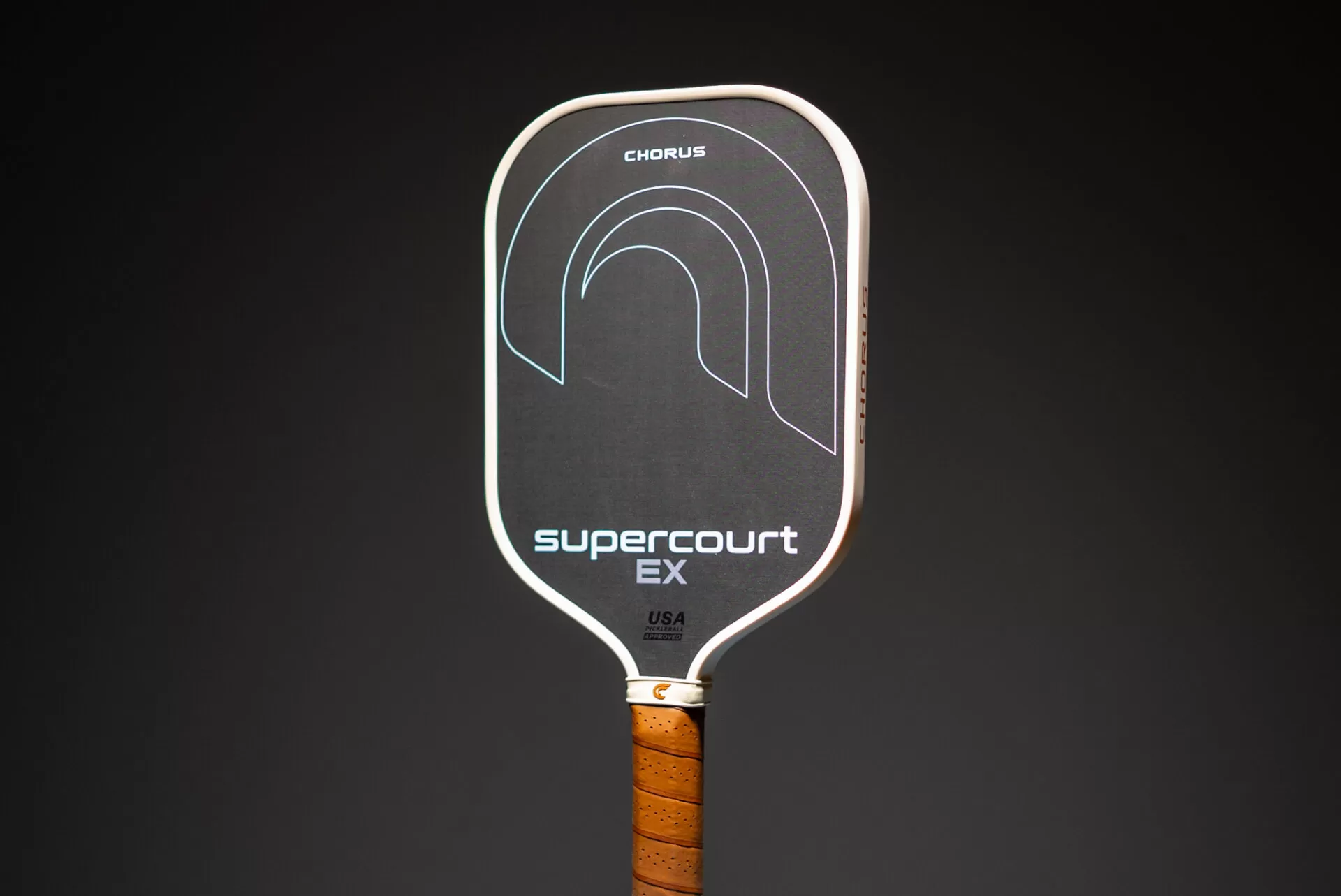
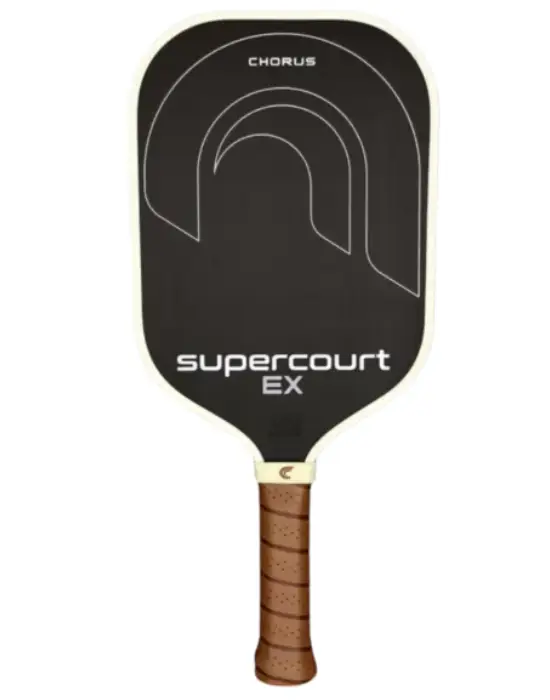
Studio Shot of Supercourt EX

Chorus Supercourt Series Performance Review

1) Lightweight and forgiving nature
All three paddles in this series weigh less than 8 ounces on average, which is lighter than most paddles that average at or above 8 ounces. They also have swingweights at or slightly below average for their shape, but above-average twistweights. Making paddles that are physically lighter and have average swingweight measurements while maintaining above average twistweight measurements is challenging. This balance makes them play well out of the box for players who like lighter paddles but also leaves room for customization with tungsten tape for those who want increased plowthrough and an oversized sweetspot.

These paddles are lightweight but still fall into the all-court category. Heavier paddles typically offer more power, so there are fewer lightweight options in the all-court category compared to the control category. These paddles are not only affordable, but these performance features help them stand out among the many paddles on the market.
2) Three shape options
Offering multiple shapes in one series is ideal. When shopping for a paddle, players look for two primary things: the right paddle profile (power, pop, maneuverability, and forgiveness) and the right shape. Many brands may offer a paddle profile you like but not in your preferred shape. One example that comes to mind is the Proton Project Flamingo. It’s a good power paddle, but it’s only offered in a single elongated shape. If that’s not your preferred shape, then you’re out of luck.
That’s not the case here. Chorus offers the series in an elongated, hybrid, and widebody shape – the perfect trio, in my opinion. What makes this even better is that this is a less expensive paddle series. Typically, the cheaper the paddle series, the fewer paddle shapes are offered for some reason, so it’s nice that they have the options even though this is technically a less expensive series. Only a few other brands do this at this price range, and it’s a differentiator.
3) Product Market Fit and Value
Most paddles around $100 are control paddles, likely for a couple of reasons. First, paddles in this price range tend to use older technology, which has typically been used in control-style paddles. Second, companies may assume that players who buy $100 paddles are beginners and prefer control paddles. I don’t think this is a smart assumption.
In this case, Chorus smartly used modern, affordable technology and avoided gimmicks that increase the price. This allowed them to create a versatile, all-court paddle at this price point, filling a gap in the market.
Who is this paddle good for?
These highly competitive all-court paddles are good options for players seeking a lightweight, all-court option. Priced at only $108 after discount, these paddles rival many more expensive all-court models. The only reasons a player might not like this paddle are if it doesn’t fit their preferred paddle profile, or if its stiffer feel doesn’t suit them.
(Get 10% off with the discount code PBEFFECT on Chours’ website)

Customization Considerations

These paddles play well out of the box for those who like lightweight paddles, but there’s also plenty of room for customization with tungsten weighted tape.
I personally preferred each paddle with a little added weight. Since the twistweight number is so high for how light the paddles are, you can add more weight to get very high twistweight numbers for improved stability while keeping the swingweight and static weight of the paddles in check.
In addition to the bump in stability with the added weight, I also noticed the feel softened up at impact and it wasn’t as stiff feeling as it was out of the box.
Chorus Supercourt Review by Shape
The three shapes offered in this series are all distinct enough from each other that you’re going to get some variety in play between them. All three shapes have a generally square design though there is a little taper to them as you go from the top of the head to the handle. Here’s the stats and descriptions for each one.

Supercourt EX

Control 84%
Power 87%
Pop 84%
Spin 92%
Forgiveness 85%
Maneuverability 84%
(Get 10% off with the discount code PBEFFECT on Chorus’ website)
Like you’d expect with this shape vs the others you get extra reach and power at the expense of some maneuverability and a smaller sweet spot. But compared to other 16mm elongated paddles you get above average forgiveness and maneuverability which makes this a very attractive elongated option in general. The weight out of the box carried through the ball well and while I preferred the other two shapes with some added weight, I actually liked this one stock.
Go with this shape if you prioritize reach & power over forgiveness and want help from your paddle to cover more court.

Supercourt HX

Control 86%
Power 85%
Pop 86%
Spin 91%
Forgiveness 88%
Maneuverability 89%

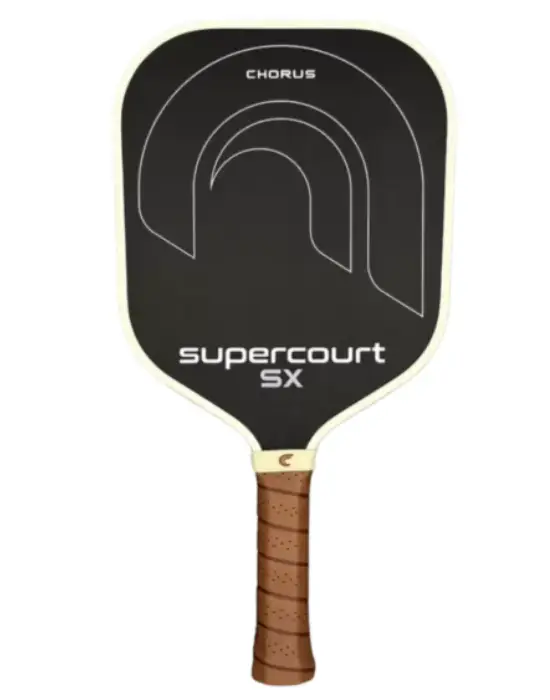
Supercourt SX

Control 86%
Power 83%
Pop 86%
Spin 91%
Forgiveness 92%
Maneuverability 96%
Most widebody shapes are 16″ x 8″. This one is slightly shorter and wider, making it an extreme widebody. This was likely done to differentiate it from the Hybrid shape. However, if you’re used to a hybrid or elongated length, switching to this wider shape will feel strange. I recommend staying with the other two shapes in that case.

Paddle Comparisons

Here are some similar paddles and paddle series that compete with Supercourts.
Honolulu J2K ($155): The J2K competes with the Supercourt HX. The J2K has a little more power and pop and isn’t quite as stiff feeling as the Supercourt though it’s not a plush feeling paddle itself. The Supercourt is more maneuverable and easier to manipulate on wristy shots vs the J2K. Though the J2K is a bit poppier I’d give the edge offensively at the net to the Supercourt HX because it’s easier to move and get the paddle into position while still having enough pop to do some damage.

Paddle Terms Glossary

Paddle Type

We’ve categorized paddles into three categories. Control, All-Court, and Power. Paddle categories are determined by Braydon after he hits or reviews the paddle.

  • Control paddles offer a softer feel and better absorbs pace off the ball but doesn’t give you as much power.
  • All-Court paddles give you a blend of power and control and does well at everything though it doesn’t excel at anything.
  • Power paddles often have a firmer feel and will return more power but are harder to control.

A paddle’s weight represents the inherent mass of the paddle as measured on a scale. However, relying solely on this static weight measurement can be misleading when assessing the true perceived heaviness of the paddle. Even if two paddles both clock in at 8 oz, their actual heft in your hand can markedly differ due to variations in weight distribution within the paddle. This is why the static weight should be considered with the swingweight of the paddle. See the definition of swingweight below.

The weight value listed in the database corresponds to the paddle’s weight that I used to gather the swingweight and twistweight measurement. It’s possible that if your paddle has a different static weight than then the swingweight and twistweight may be slightly different.

There are three primary shapes a paddle can have which consists of the length and width of the paddle. These three shapes are:
  • Elongated: The dimensions for an elongated paddle are 16.5″ x 7.5″.
  • Standard: A standard shaped paddle has dimensions of 16″ x 8″.
  • Hybrid: A hybrid shaped paddle falls somewhere in between the standard and elongated shapes, with approximate dimensions of 16.25″ x 7.5″-7.7″.
Then there are two less common shapes you’ll see. These are:
  • Extra-Elongated: This shape is 17″ x 7″
  • Widebody: This any paddle shorter than 16″ long.
When considering the advantages and trade-offs of paddle shapes, it’s important to understand the characteristics of each shape.
  • Elongated Paddle: An elongated paddle offers increased reach, spin, and power. However, this additional reach comes at the expense of forgiveness, particularly from side-to-side.
  • Standard Paddle: In contrast, a standard-shaped paddle provides less reach and a little less power & spin but offers greater overall forgiveness. This means that while you may not have the same extended reach as an elongated paddle, you gain better control and stability.
  • Hybrid Paddle: The hybrid shape serves as a middle ground between the elongated and standard shapes. It provides a balance between reach and forgiveness, offering players a versatile option that combines aspects of both shapes.
It’s interesting to note that advanced players often prefer elongated shapes. On the other hand, players at lower skill levels typically opt for the extra forgiveness offered by standard shaped paddles. Ultimately, the choice of paddle shape depends on an individual’s playing style, preferences, and skill level. Whether your focus is on reach or forgiveness, understanding the unique benefits and trade-offs of each shape can assist you in selecting the paddle that best suits your game.

Swingweight is a measure of the paddle’s resistance to swinging about the end of the handle. The higher the swingweight number the heavier it will feel in your hands. A higher swingweight has more power but is harder to swing, lower swingweight is easier to swing but has less power. Sometimes a faster swing with a lower swingweight can make up for power lost in swingweight. The price paid for that is greater impact shock. Stock swingweights will vary between 100 – 140.

Twistweight is the resistance to rotating around the long axis through the middle of the paddle from butt to tip. The higher the twistweight the more resistance the paddle has to rotating on off center hits. This measurement is closely related to the amount of forgiveness or the size of the sweet spot of the paddle. A higher twistweight indicates a bigger sweet spot. Twistweight numbers range from 5 – 8.

Measuring the revolutions per minute (RPMs) off of a serve you get a number that shows the spin potential of a paddle. Using these RPM measurements I’ve created five buckets that a paddle will fall into indicating its overall spin potential. The five buckets are:

1900 or Higher = Very High
1700 – 1900 = High
1500 – 1700 = Medium
1300 – 1500 = Low
1300 or less = Very Low

You can tell a big difference in the amount of spin a paddle generates when you compare a Very High paddle to a low paddle. But the gains from Medium to High to Very High are marginal. We’ve found that having at least a medium rating is often enough if you’re looking for a good spin paddle. However, if you’re a big hitter then you will benefit more from a high spin paddle to help you keep the ball in play more often.

The power level of a paddle is shown in miles per hour (MPH) after taking ten measurements with a speed gun of hitting a serve as hard as I can. This measurement gives you an idea of how hard you can hit the ball when given the chance to take a full swing. So shots like serves, drives and overheads. The higher the MPH reading the more power you can generate with the paddle.

I also show the percentile ranking of the measurement to give you an idea of how it stacks up against the rest of the paddles in my database.

The pop level of a paddle is shown in miles per hour (MPH) after taking the average of ten speed gun measurements of hitting a punch volley as hard as I can. This measurement gives you an idea of how hard you can hit the ball on shorter swings and gives you an idea of how quickly a ball comes off the face when you apply less force on the ball. So shots volleys, dinks, counters, and resets are all affected by the pop measurement. The higher the pop measurement the stronger your counters will be but it takes more skill to keep the ball from floating or popping up on you when resetting a hard hit ball or when dinking.

I also show the percentile ranking of the measurement to give you an idea of how it stacks up against the rest of the paddles in my database.

The term “forgiveness” pertains to both the size of the sweet spot and the stability of the paddle. A paddle that is more forgiving offers a larger sweet spot, greater stability, and yields more power when hitting off-center shots. On the other hand, a less forgiving paddle has a smaller sweet spot and does not provide as much power when hitting off-center shots.

While there seems to be only benefits of more forgiving paddles, less forgiving paddles are often more maneuverable and is easier to generate more paddle speed.

Reviewer Profile
Braydon competes at the 5.0 level and plays in 5-10 tournaments a year. He plays/drills 3 to 4 times a week and would play more if time allowed it.
Braydon Unsicker
5.04 DUPR

Related Tags

Related Posts