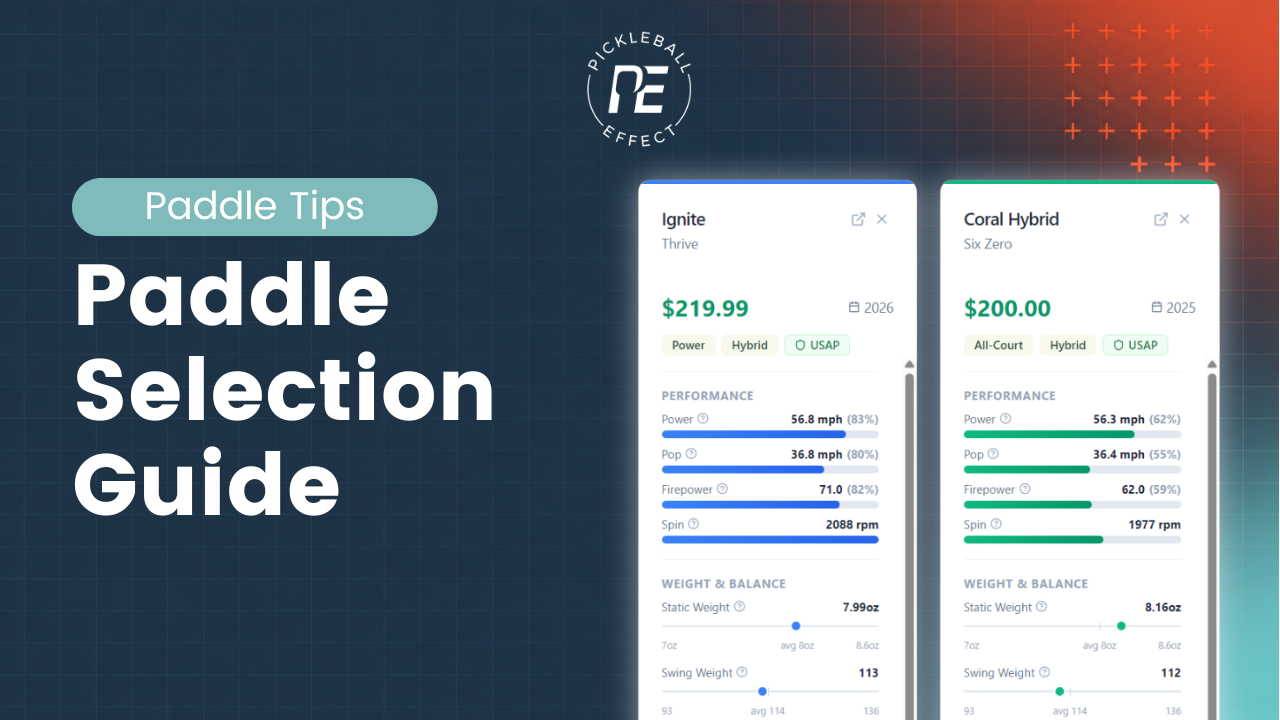

Over the past few years, pickleball paddle development has heavily leaned toward power. Brands kept chasing more pop, faster ball speed, and easier offense because that’s what many players wanted.
But lately, things have started shifting.
We’re seeing more high-level players move back toward balanced all-court paddles, and even brands known for power are beginning to focus more on versatility and control. With Selkirk’s launch of their new all-court paddle that will likely get a lot of attention, this conversation is only getting bigger.
For a long time, I leaned heavily toward recommending all-court paddles for most players. But over time, my perspective has changed.
I think the answer depends on three things:
Some players want long-term development. Some want easier offense and faster results. Others simply want to have more fun on the court.
Affiliate disclosure: If you click the links on the page or use our discount codes, we may earn a small commission at no extra cost to you that supports our testing and reviews.

At lower and intermediate levels, I think the answer depends heavily on what you want out of the game right now.
Should You Pick a Power Paddle?
If your goal is less about long-term improvement and more about immediate results, aggressive play, and overall enjoyment, then a power paddle can make a lot of sense.
These paddles are built to create offense through more pop, faster ball speed, and easier put-away power. And at these levels many players still struggle handling pace, defending drives, letting out balls go and resetting hard balls consistently.
Points are often shorter, pace is more effective, and extra paddle-generated offense can create immediate advantages without requiring perfect mechanics.
For many recreational players, that’s a completely valid reason to choose power. Not everyone is trying to maximize long-term development or become a high-level tournament player. Some players just enjoy feeling effortless pace come off the paddle face.
A power paddle makes sense if:
The Tradeoff With Choosing Power
The downside is that power paddles can sometimes mask weaknesses and slow development.
If your paddle is generating much of the offense for you, skills like resets, touch, drops, transition play, and creating your own pace naturally can lag behind. Players can also start defaulting to power because it becomes the easiest way to win points, which can limit the development of other ways to create pressure and win rallies.
And while power matters at every level, higher-level players are much better at handling pace and extending rallies. That means offense alone becomes less effective, and players eventually need more consistency, touch, adaptability, and creativity to keep progressing and winning.
Should You Pick an All-Court Paddle?
If your goal is long-term improvement and becoming a more complete player, I think all-court paddles are often the better option.
Because they are generally more balanced and predictable, they tend to help you develop longer strokes and proper mechanics for better touch and resets.
An all-court paddle also forces players to learn how to generate pace through mechanics, timing, and technique instead of relying heavily on paddle-generated power.
The tradeoff is that you may not win as easily right away compared to someone using a very explosive power paddle at the same level. But over time, that development can create a more complete and adaptable player.
An All-Court Paddle Makes Sense If:

At higher levels, the decision between an all-court or power paddle becomes much more nuanced.
Many advanced players can already generate some power naturally and manage incoming pace effectively. Because of that, paddle choice becomes less about adding a missing skill and more about supporting what makes you good.
Every higher level player has at least one part of their game that is 5.5+ level. Whatever that skill is, it’s often what helps them win most consistently. Your paddle should align with and amplify that strength.
Should You Pick a Power Paddle?
If your ability to create ball speed makes opponents uncomfortable and creates opportunities for your team, then leaning into a power paddle can make a lot of sense. It can help you create even more pressure and become even more dangerous when attacking and finishing points.
It’s also important to remember that there are different levels of power paddles. You do not have to go all in on the most explosive option available.
I generally break power paddles into three categories: low, mid, and high power. The goal is to find the level of power that amplifies your strengths without sacrificing too much of the rest of your game. Essentially, get as much power as you can confidently manage.
A power paddle makes sense if:
Should You Pick an All-Court Paddle?
If your strengths are consistency, precision, resets, counters, placement, and creativity, then an all-court paddle makes more sense.
At advanced levels, balanced all-court paddles are especially good for versatile players who benefit from more predictability and consistency under pressure when receiving pace.
There are real advantages to having a paddle that gives you more confidence in transition, resets, and placement. There are lots of ways to apply pressure than just power. Getting the ball back more often is a form of pressure, placement is a form of pressure, spin is a form of pressure, etc. That predictability also allows advanced players to be more creative and apply a variety of types of pressure.
There are also different levels of all-court paddles. Some lean more balanced while others sit very close to the power category. Choosing an all-court paddle does not mean giving up offense entirely. Many all-court paddles still generate plenty of power while offering more predictability and versatility overall.
An All-Court Paddle Probably Makes Sense If:
Trying to Compensate for Weaknesses Instead of Leaning Into Strengths
One common mistake is players choosing paddles to compensate for weaknesses instead of amplifying strengths.
For example, if generating big finishing power is not naturally part of your game, switching to an extremely powerful paddle will not suddenly make you an elite finisher.
Meanwhile, the added pop may hurt you in transition, defense, resets, and hand battles.
At higher levels especially, compensating an area of personal weaker performance often comes with bigger tradeoffs elsewhere.
Thinking Advanced Players Should Default to Power Paddles
This mindset is very common because people assume advanced players are skilled enough to handle power paddles well.
And while that is true to some degree, there are still major advantages to the predictability and versatility of all-court paddles in certain situations. For many advanced players, having slightly less power but more confidence in resets, counters, transition play, and consistency under pressure makes them a better overall player.
Choosing the best paddle type at advanced levels is much more nuanced than the blanket idea that better players should automatically use more power.
I think the real answer comes down to three things:
At lower levels, power paddles can create major advantages because many players still struggle handling pace consistently.
At higher levels, the decision becomes more nuanced because most advanced players can already create and defend pace effectively. That’s when paddle choice becomes more about supporting your identity and strengths as a player rather than trying to fix weaknesses.
Neither choice is wrong.
The best paddle is the one that aligns with your goals, complements your strengths, and helps you enjoy the way you play the game.
An all-court paddle balances offense, control, forgiveness, and consistency rather than maximizing one specific trait.
A power paddle is designed to create easier offense through more pop, faster ball speed, and easier put-away power.
It depends. They can help lower-level players create easier offense and win more free points but can slow player development.
Potentially. Some players become overly reliant on paddle-generated offense and develop touch and control skills more slowly.
Many advanced players already create enough pace naturally and and need more consistency, defense, and precision to apply pressure in multiple ways.
No. If a power paddle makes the game more enjoyable and helps you play with confidence, that is a perfectly valid reason to use one.
Reviewer Profile
Braydon Unsicker is the founder of Pickleball Effect and has been reviewing pickleball gear since 2020. He’s known for independent, data-backed paddle reviews and hands-on testing that help players cut through marketing claims and make smarter equipment decisions.

Click button to activate sitewide discount.
Affiliate disclosure: If you click the links on the page or use our discount codes, we may earn a small commission at no extra cost to you that supports our testing and reviews.