There are more good pickleball paddles available today than ever before. That’s great news for players, but it also makes choosing your next paddle more difficult.
Since 2020, I’ve reviewed and tested hundreds of paddles and helped thousands of players find the right fit. That experience has shaped this simple, repeatable system that I genuinely believe is the clearest and most effective guide to help you find a paddle that matches your game.
It comes down to three simple decisions:
Once you’ve narrowed those down, we’ll use optional secondary filters like handle length and swing weight to refine your search. Then we’ll use my paddle database to identify the paddles that fit your needs.
Let’s get started!
Looking for the right paddle to fit your game? Take our paddle fitting quiz for three recommendations that will match your style of play.
The first and most important question is:
How much power and control do you want?
Every paddle falls somewhere on a spectrum between offense and control. While every paddle is unique, I generally think of paddles fitting into one of three broad categories:
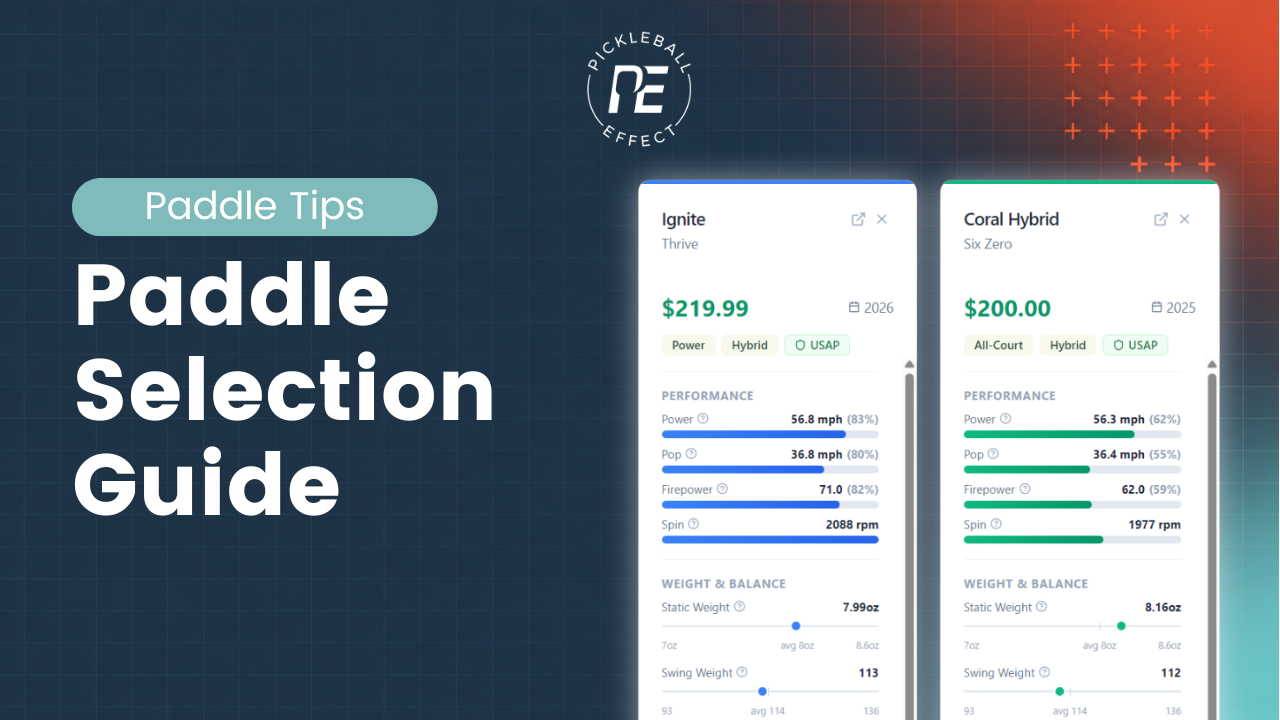
The easiest way to determine where you sit on this spectrum is to look up your current paddle in my paddle database.
Firepower combines the power and pop into a single score that represents a paddle’s overall offensive potential.
You’ll see both a Firepower Score and a Firepower Percentile in parenthesis.
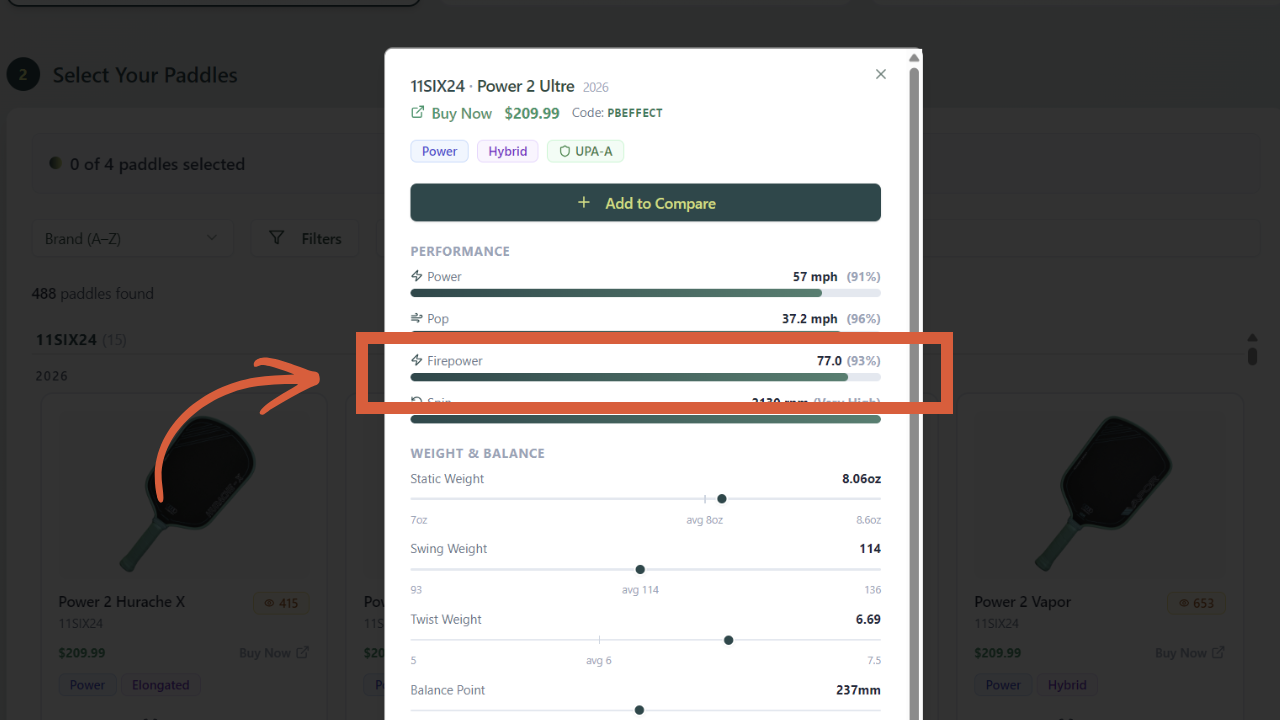
The percentile shows where your paddle ranks compared to the hundreds of paddles I’ve tested. The higher the percentile, the more offensive the paddle.
In the 11SIX24 Power 2 Ultre example above, it has a Firepower Score of 77 and a Firepower Percentile of 93%. That places it among the most offensive paddles I’ve tested.
Here’s a Firepower score guide:
| Firepower | Category |
|---|---|
| 0–40 | Control |
| 40–70 | All-Court |
| 70–85 | Power |
| 85–100 | Big Power |
Once you’ve identified your current paddle’s Firepower level, ask yourself a simple question:
Do I like this power level, or do I want more or less of it?
The answer will help you determine what performance profile you should target next.
If you don’t want to go through that exercise or your paddle isn’t in my database, you can also simply decide whether you think you’d benefit most from a control, all-court, or power paddle and you can use that later when we use my database to filter for your paddle.
Here are some addtitional thoughts on how to choose the right performance category for you.
Stay in the same performance category.
This is one of the biggest mistakes players make when shopping for a new paddle. They like their current power and control balance but end up changing it because a new paddle is popular or heavily marketed.
If you generally like how your paddle performs, there’s no reason to reinvent everything. Focus on improving other characteristics instead.
Move up one category or even just increase the firepower within your current paddle’s category.
Examples:
Small adjustments are usually easier to adapt to than dramatic jumps. The goal is to improve on what you have, not completely change the way your paddle plays.
Move down one category or even just lower firepower within the category of your current paddle.
Examples:
Small adjustments are usually easier to adapt to than dramatic jumps. The goal is to improve on what you have, not completely change the way your paddle plays.
By the end of this step, you should have a good idea of whether you’re looking for a control, all-court, power, or big power paddle. Once you’ve narrowed that down, it’s time to determine which shape best fits your game.
We’ve partnered with Pickleball Central to give you up to 10% off paddles, shoes and gear. Some Exclusions apply.
Click link below to apply discount at checkout.
Once you’ve narrowed down your preferred performance profile, it’s time to think about shape.
Shape has a major impact on how a paddle behaves on court.
It influences:
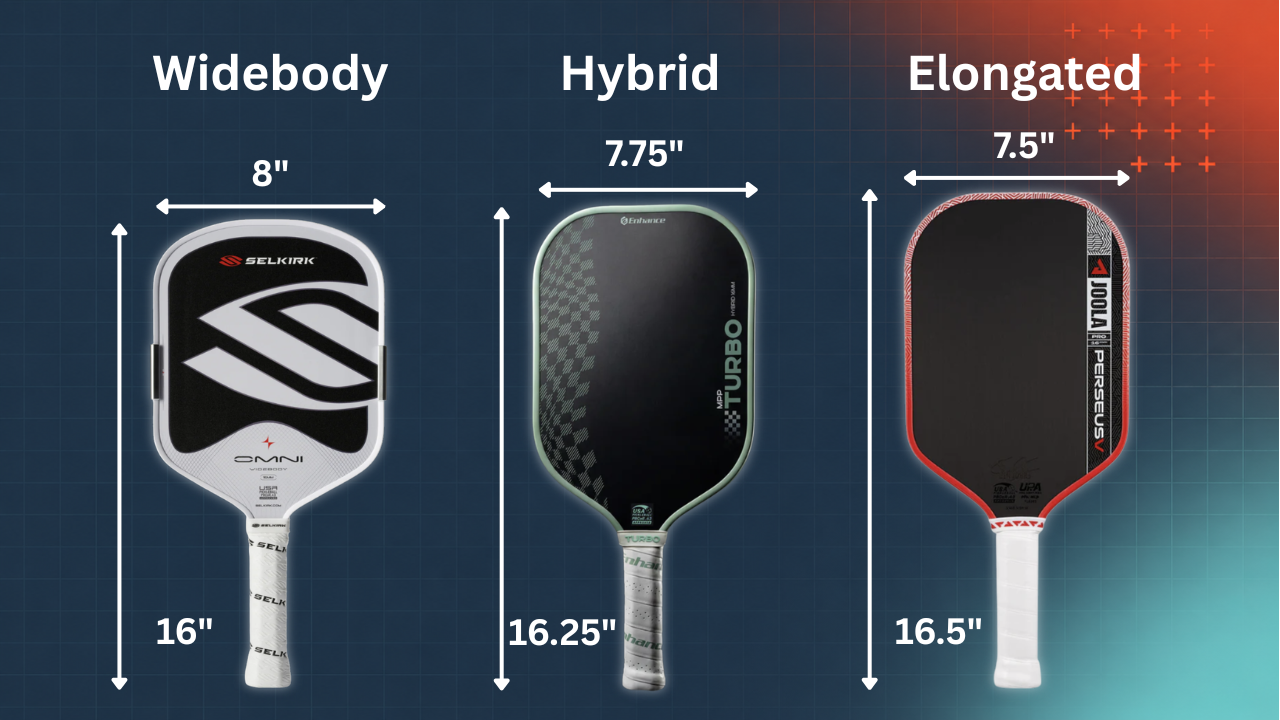
The three shape categories are elongated, hybrid, and widebody.
Elongated paddles are longer and narrower and typically measure 16.5” x 7.5”.
Characteristics:
Many aggressive and advanced players gravitate toward elongated shapes because of the added reach at the kitchen and offensive potential.
The tradeoff is that they are often less forgiving and less maneuverable than other shapes.
Hybrid paddles sit between elongated and widebody designs and typically measure 16.25” x 7.75”.
Characteristics:
Hybrid shapes have become incredibly popular because they do a lot of things well without having any major weaknesses.
Widebody paddles are shorter and wider which prioritizes forgiveness, stability, and maneuverability and typically measure 16” x 8”
Characteristics:
Widebody paddles are easier to play with and don’t punish mistakes as much as an elongated and hybrid paddle does. Good for players who value consistency and hand speed for counters but you give up some reach and power compared to their hybrid and elongated counterparts.
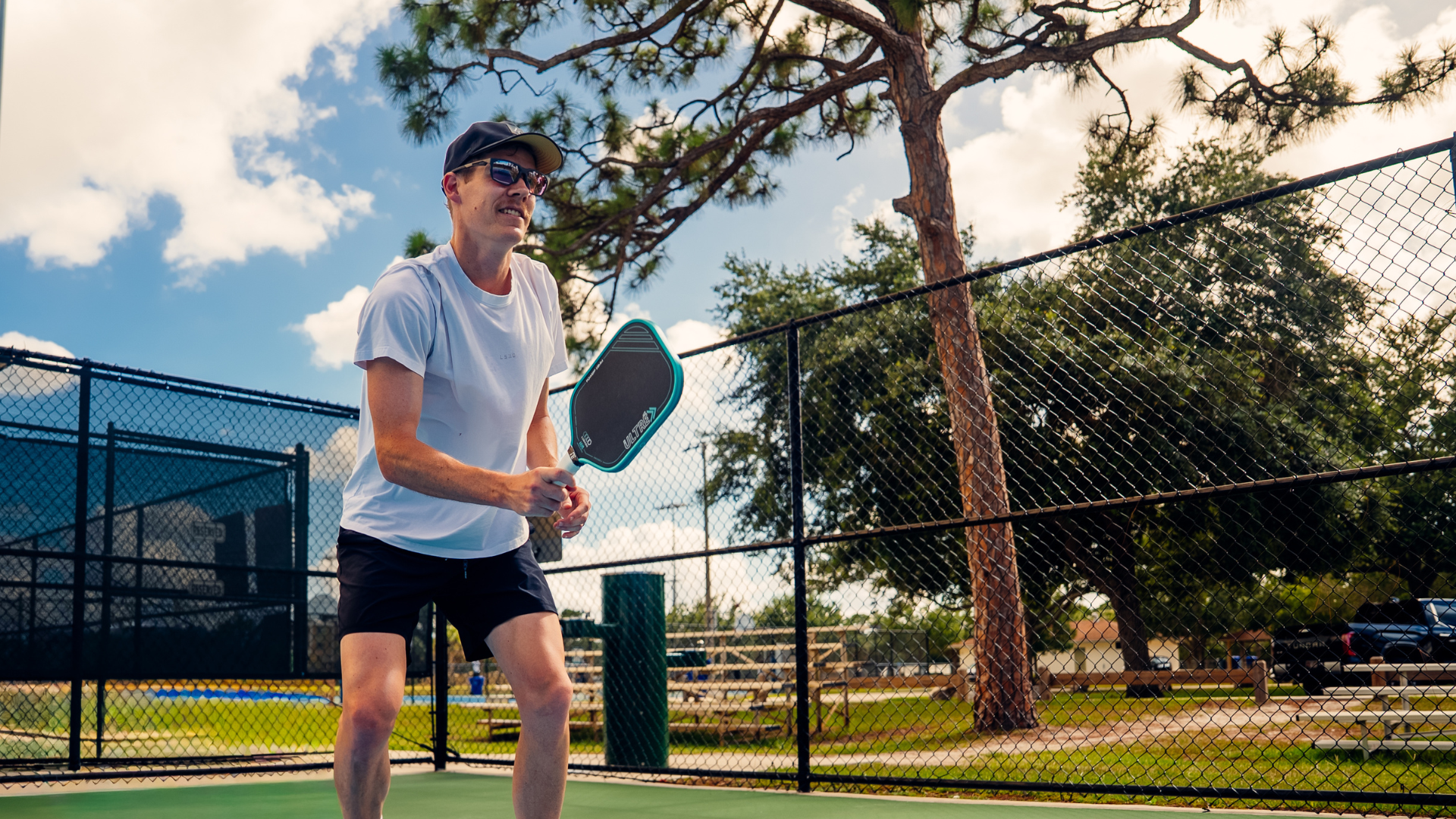
You’ll often hear players say elongated paddles are for power and advanced players, while widebodies are for beginners and control players. Maybe you could’ve said that 3 years ago, but it’s not true anymore. Today you can find power paddles in widebody shapes and control paddles in elongated shapes.
The bigger differences are sweet spot location and weight distribution. I like to ask people where they tend to make contact the most and when they miss, where do they miss? If you often hit toward the tip of the paddle, an elongated or hybrid shape will usually suit you better. If you tend to miss toward the sides or your contact is just a little inconsistent all over the face, a hybrid or widebody is usually the better fit.
Then there’s weight distribution. Elongated paddles place more weight farther from your hand, which is why they typically feel heavier to swing and have higher swing weights. In general, elongated paddles have the highest swing weights, hybrids fall in the middle, and widebodies have the lowest, making them feel quicker and easier to maneuver. If you value quick hands and forgiveness across the width of the paddle, go with a widebody. If you want more weight behind the ball or your swing naturally feels better with a higher swing weight, especially if you come from a tennis background, an elongated paddle is usually the better fit.
If you’ve been playing pickleball for a while and like your current paddle shape, stick with it.
This is a mistake I see players make all the time. They find a shape they play well with, then abandon it because a new paddle with a different shape gets a lot of attention online. Unless you have a specific reason to switch, like you want a bigger sweet spot, a lighter feel, or quicker hands, there’s no reason to change. You’ve likely built your swing and your game around the shape you’re already comfortable with. Changing shapes changes how you swing, which is a bigger change than many realize.
If you aren’t committed to a particular shape, you’re undecided, or you’re still figuring out what you like, I’d recommend starting with a hybrid or widebody.
Elongated paddles have historically been the most popular shape because they’re what most pros use, although that’s starting to change. They’re also the most demanding. They typically have higher swing weights and a narrower sweet spot, so I usually encourage players to at least try a hybrid or widebody, especially if they primarily play doubles. In doubles, quick hands and maneuverability at the kitchen matter a lot during fast exchanges and counters, and hybrid and widebody paddles generally provide more of both than the extra reach and leverage an elongated paddle offers.
Consider moving:
Reach is one of the primary benefits of moving toward a longer paddle shape.
Consider moving:
As paddles get wider, they generally become more forgiving.
Hybrid and widebody paddles are often easier to maneuver during fast exchanges at the kitchen.
Widebody paddles tend to offer the highest levels of forgiveness and stability, making them a good option for players who prioritize consistency.
Hybrid shaped paddles are the most popular.
Data from my Main Paddle Monitor which shows the primary paddle of over 1700 active players shows that 42% of players use a hybrid, 41% use an elongated, and 17% use a widebody.
We’ve partnered with Pickleball Central to give you up to 10% off paddles, shoes and gear. Some Exclusions apply.
Click link below to apply discount sitewide.
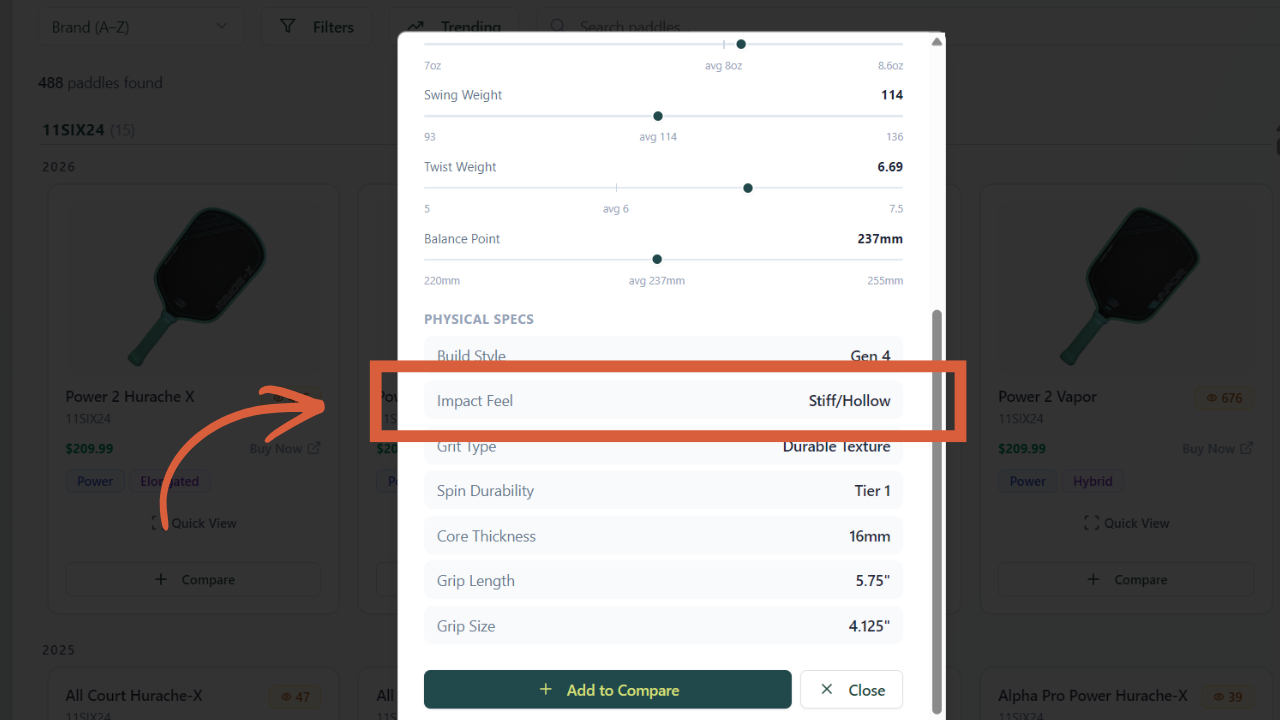
Impact feel or the paddle’s feedback is one of the most overlooked parts of choosing a paddle.
Two paddles can have similar power, similar shapes, and nearly identical specifications, yet have a completely different impact feel or sensation the moment the ball hits the face.
That impact feel affects your confidence, comfort, and overall enjoyment of playing with the paddle.
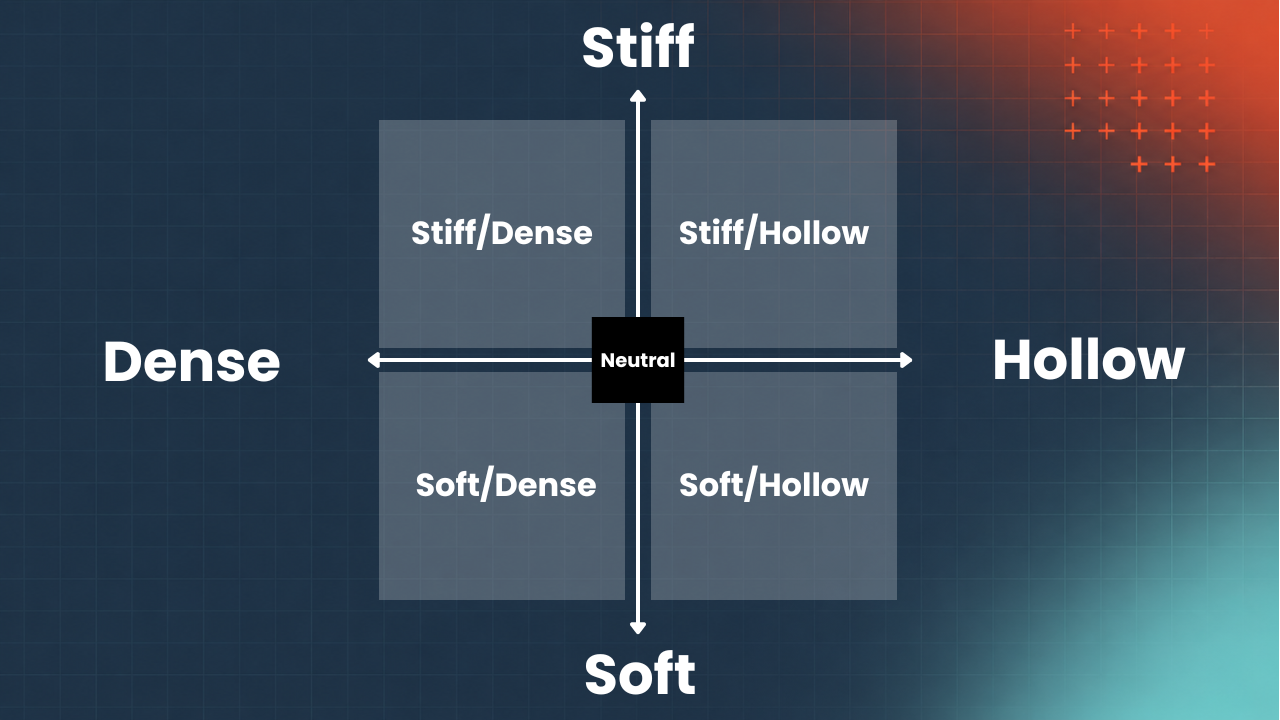
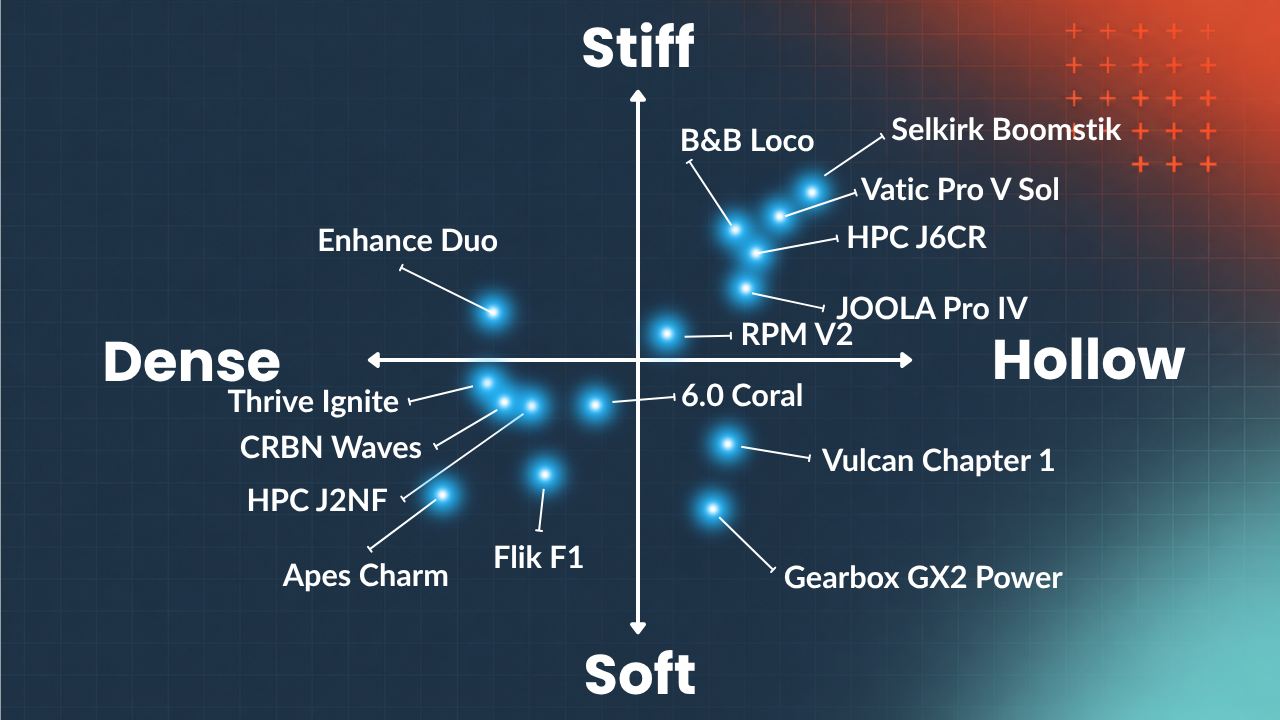
I think of impact feel as two spectrums: stiff to soft and hollow to dense. Every paddle falls somewhere within those two dimensions.
Stiff / Hollow – A crisp, lively impact feel with a noticeable hollow sensation at contact. Many modern foam-core power paddles fall into this category, making it one of the most common impact feels. Players associate this as the category with the most paddle feedback for enhanced connection with the paddle while others can describe it as somewhat harsh feeling.
Soft / Hollow – A plush feel combined with that same hollow sensation. Less common than stiff/hollow, but many players love the unique combination of comfort and responsiveness. The softness offers a comfortable feel while the hollowness provides some feedback.
Stiff / Dense – One of the less common categories. These paddles have a crisp, higher-pitched impact but still feel solid at contact rather than hollow.
Soft / Dense – Another very common category. These paddles combine a plush impact sensation with a solid, connected feel that many players describe as smooth or buttery. There are some players that say this category is too muted and you lose some feedback from the ball.
Neutral – This is the area that is in the middle of the feel map and doesn’t fit neatly into one of the other categories.
Here are some examples of where paddles fall on this feel map.
This is one of the harder parts of paddle selection because it usually takes some trial and error.
The easiest way to determine your preference on this spectrum is to look up your current paddle in my paddle database.
If you like how your current paddle feels, look for something with a similar impact feel. If it feels too soft, too stiff, too hollow, or too dense, you’ll have a much better idea of which direction to go on your next paddle.
Once you’ve identified your preferred performance profile, paddle shape, and impact feel, you’ve already done the most important work. At that point, you can skip to the final step and use those as filters in my paddle database, or continue reading to use the secondary considerations below to narrow your options even further.
The majority of paddles today have a 5.5-inch handle, which has become the gold standard. It’s long enough for a comfortable two-handed backhand while maintaining a balanced feel and good leverage.
You’ll still see some variation. Handles between 5.5 and 6 inches provide a little more room for two hands and slightly more leverage. Shorter handles, on the other hand, give more of the paddle’s overall length to the face, which can increase the hitting surface and often improve the sweet spot, but they make two-handed shots less comfortable.
In general, I recommend sticking with a handle that’s 5.4 inches or longer. There are exceptions, such as players with smaller hands or those who never hit a two-handed backhand, but for most players it’s the safest choice.
You’ll hear a lot of construction terms thrown around, including:
Construction influences things like:
Construction absolutely matters, but I recommend using it as a filtering tool rather than your starting point.
Most players should first decide their performance profile (control, all-court, or power), paddle shape, and impact feel. Once you’ve done that, construction type becomes an easy way to narrow your options.
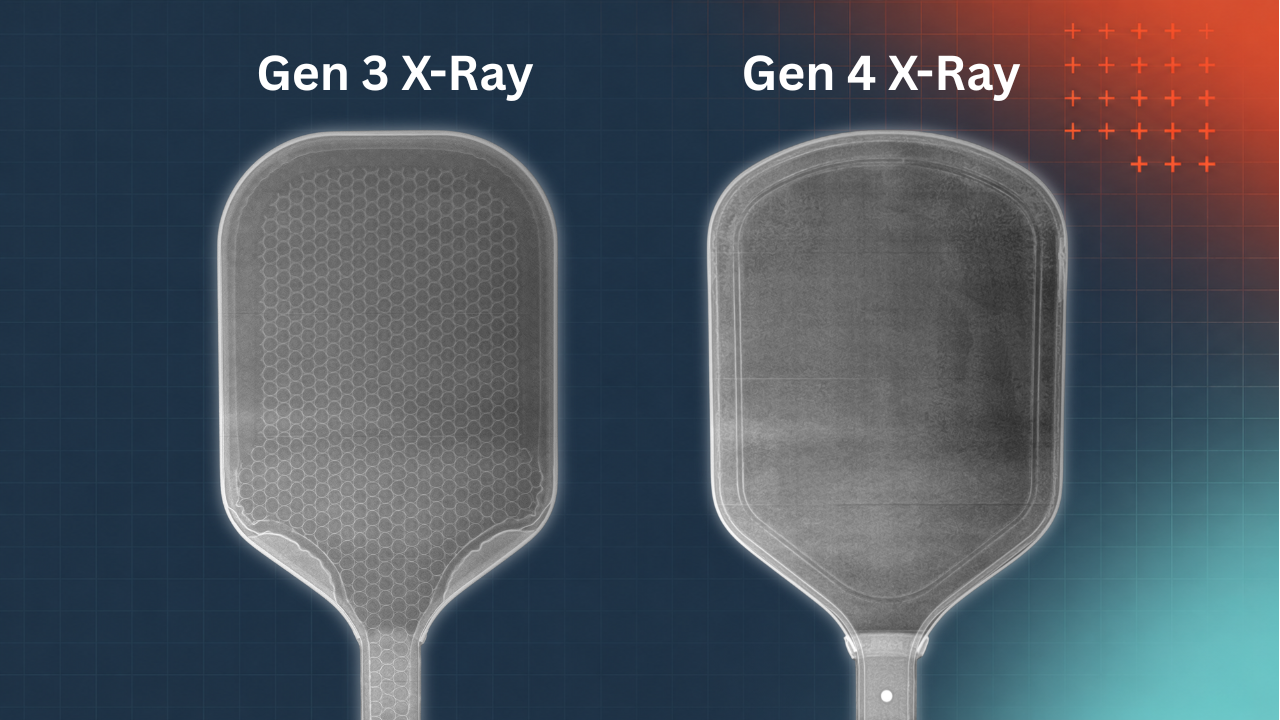
As a general rule, I’d focus your search on Gen 3 and Gen 4 paddles, as they represent the most modern paddle designs.
Gen 3 paddles add foam around the perimeter of a honeycomb polymer core, which increases sweet spot, adds power and allows for more performance profiles.
Gen 4 paddles take that a step further by incorporating foam throughout the paddle’s core rather than just around the edges. This gives manufacturers even more control over how a paddle feels and performs, allowing them to create larger sweet spots, improve consistency, and fine-tune power and feel. Additionally, Gen 4 paddles are more durable which gives them an edge over Gen 3 in most cases.
That doesn’t automatically make every Gen 4 paddle better than every Gen 3 paddle. There are outstanding paddles in both categories. But if you’re buying a new paddle today, Gen 3 and Gen 4 are where most of the industry’s innovation is happening, and nearly every major brand’s flagship paddles use one of these construction methods.
Older thermoformed and Gen 2 paddles can still be great options, especially if you’re shopping on a budget. Just don’t start your search by asking, “What’s the best Gen 4 paddle?” Instead, figure out the performance profile, shape, and impact feel you want first, then use construction type as one final filter to narrow your options if you would like to.
These numbers influence how a paddle swings and reacts, but I consider them a secondary consideration because they are so heavily influenced by paddle shape.
Even so, there’s plenty of variation within each shape. Some elongated paddles swing more like hybrids, and some hybrids are nearly as maneuverable as widebodies. That’s why it’s worth comparing the specifications of the paddles you’re considering rather than assuming they’ll all play the same simply because they share a shape.
There are four numbers worth paying attention to:
Across the hundreds of paddles in my database, these are the typical ranges:
| Shape | Typical Swing Weight | Typical Twist Weight | Typical Balance Point |
|---|---|---|---|
| Elongated | 114–120 | 5.9–6.3 | 239–244 mm |
| Hybrid | 111–115 | 6.2–6.7 | 236–240 mm |
| Widebody | 107–112 | 6.6–7.2 | 233–238 mm |
Unless you know you have a strong preference, I wouldn’t obsess over these numbers. They’re best used to compare paddles that are already similar. If you’re deciding between two hybrid all-court paddles, for example, swing weight and twist weight can help you decide which is better for you.
Now you know what you’re looking for and are ready for the final step.
Open the Paddle Comparison Tool and click Filters under the Browse Paddles section.
Apply these three primary filters first:
Finally, under Specifications → Year Released, filter for newer releases so you’re primarily looking at modern paddle designs.
Those filters alone will narrow hundreds of paddles down to a much smaller list that matches your preferences.
From there, use secondary filters like swing weight and handle length to refine your options even further if you have any preferences there.
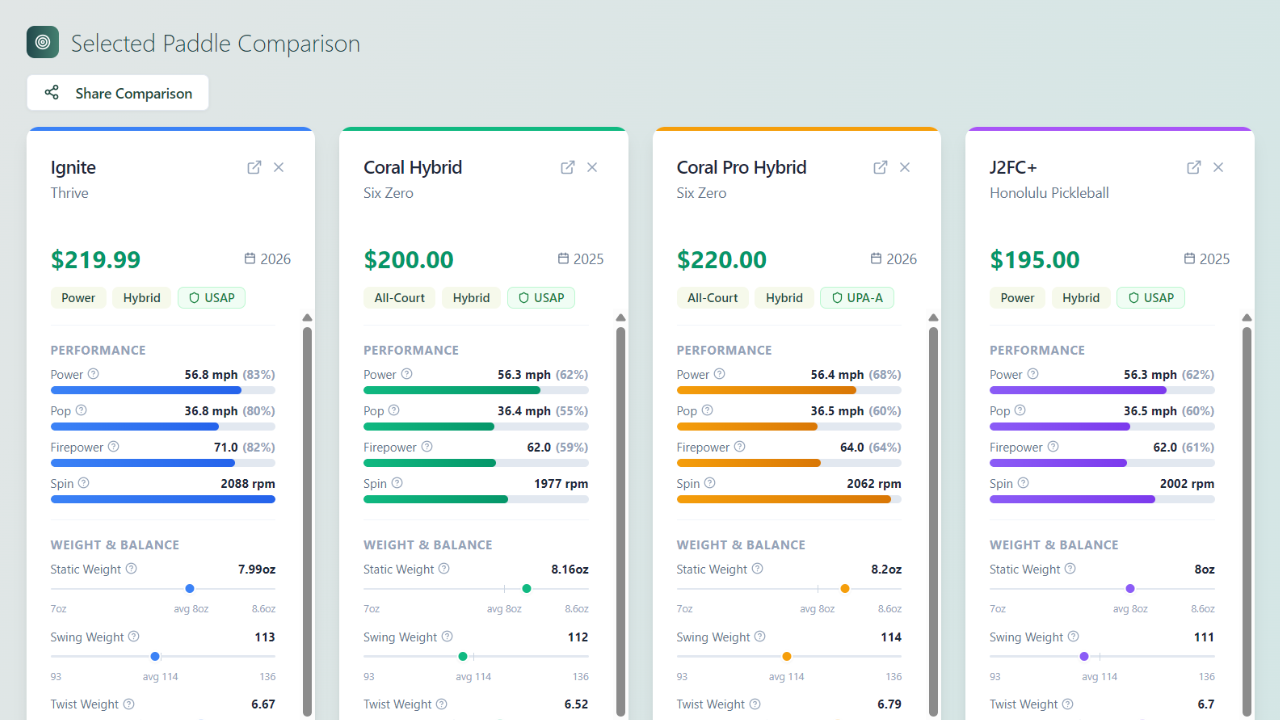
Once you’ve narrowed the list to a few paddles, you’ll see your narrowed down list below. From there you use the Quick View button to browse the options and select up to four paddles to Compare and view them side by side to find the right paddle for you.
Once you find the right paddle you can use my promo codes to save money on your purchase and to help support our review efforts.
Reviewer Profile
Braydon Unsicker is the founder of Pickleball Effect and has been reviewing pickleball gear since 2020. He’s known for independent, data-backed paddle reviews and hands-on testing that help players cut through marketing claims and make smarter equipment decisions.

Click button to activate discount at checkout.
Looking for the right paddle to fit your game? Take our paddle fitting quiz for three recommendations that will match your style of play.