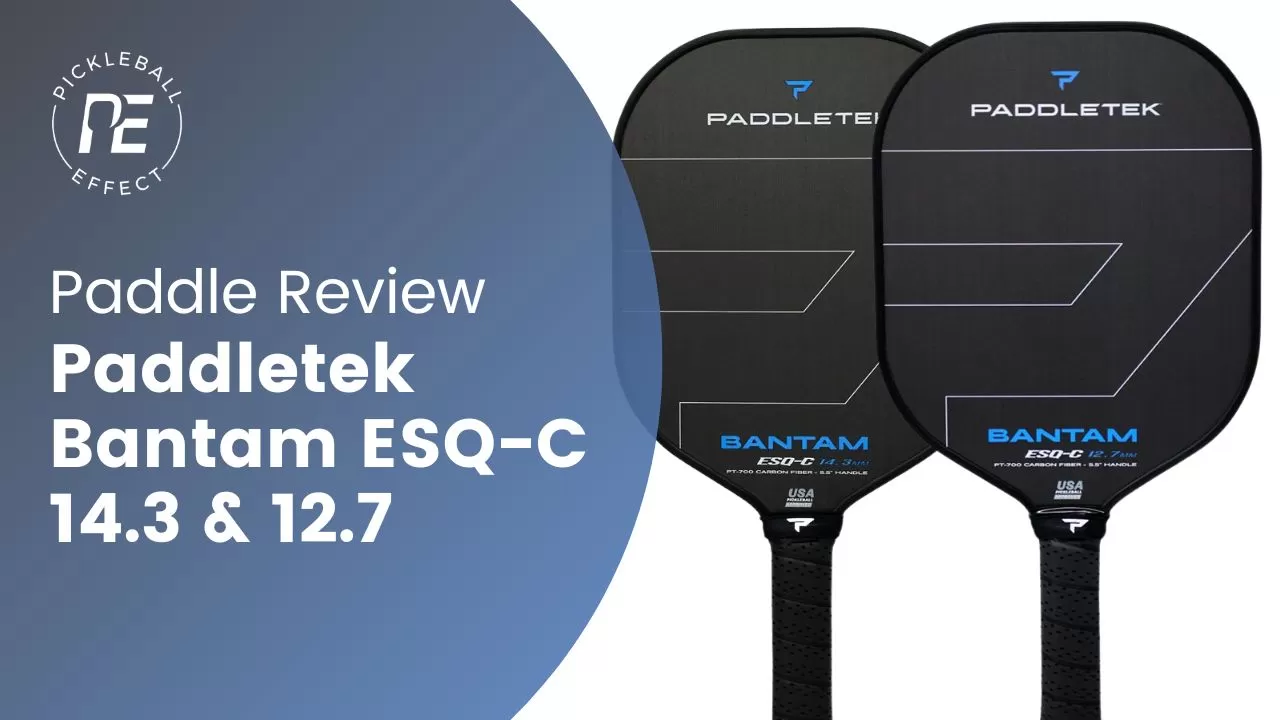
Paddletek is one of the original major paddle manufacturers but felt dormant for years until they started to gain popularity again mid 2024 with the release of their Bantam TKO-C paddles. Following the success of the TKO-C series, they made handle improvements to the Bantam ALW-C paddles and recently launched the new Bantam ESQ-C model on Oct 1, 2024. The ESQ-C appears to share many similarities with the ALW-C paddles. The sudden appearance of this paddle raises questions about its origins and the company’s strategic direction. However, the paddle is different from the ALW-C paddle and the story behind it is great. I have the story for you and I share my review of how the paddles play which turned out to be really good. They offer a unique combination of power, pop, and extreme maneuverability.
Looking for the right paddle to fit your game? Take our paddle fitting quiz for three recommendations that will match your style of play.
(Get 10% off with the discount code 10EFFECT from either website)
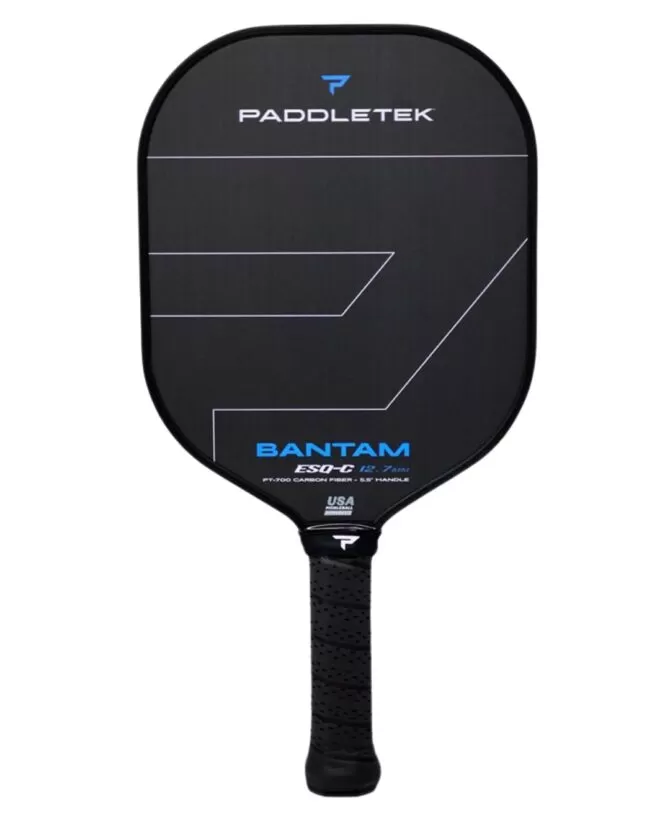
Control wise the paddle was surprisingly easy to hit drop shots with and slow the ball down from the baseline when you were under pressure but as you worked your way to the net the tricker to control it got because of its poppy nature. It had a good sweet spot though not oversized like many standard shaped paddles due to its lighter nature and thinner core. I added 3 inches of half gram per inch tungsten tape to each corner improve stability and plowthrough and I liked that set up. It felt a little flimsy straight out of the box because it’s so light but this set up minimized the total amount of weight added while still bumping the swingweight up to 111. Giving you more stability and power without ruining the fast nature of the paddle.
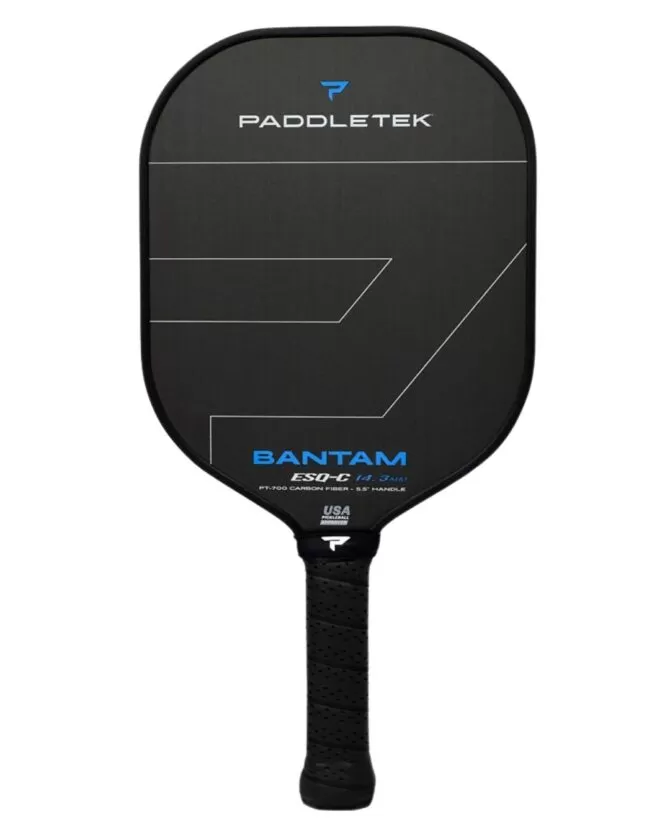
The ESQ-C 14.3 is also very lightweight but is more stable and carries through the ball better than the 12.7 out of the box. Its power is a similar level as the 12.7 but its pop is toned down in comparison though still higher than most standard shaped paddles. It’s toned down enough that I would categorize it as an all-court paddle and not a power paddle. It’s still a nice addition to the standard shaped category because there aren’t many all-court style standard shaped paddles either.
The paddle still brings offense and improves your hand speed and counters at the net but with some added touch for resets and dinks. It was easier to connect with and control this paddle than the 12.7. The sweet spot felt good and was above average to nearly oversized. It was more plush feeling than the 12.7 and it’s elongated TKO-C 14.3 counterpart. Though it’s not your traditional plush feeling, something about the Paddletek Bantam paddles give them a unique feel that is more hollow, pingy, and light feeling at impact. Not an ugly or bad feel, just different from your typical paddle.
Because the ball didn’t jump off as quickly as the 12.7, it was easier to find angles on cross court speed ups and crosscourt dinks without flying the ball wide a few inches. It was just a little easier to play in general that way and required less precision than the 12.7.
The grip circumference of the 14.3 is blockier and thicker at 4.5″. It was uncomfortable to me and I preferred the octagonal 4.25″ circumference of the 12.7 model.
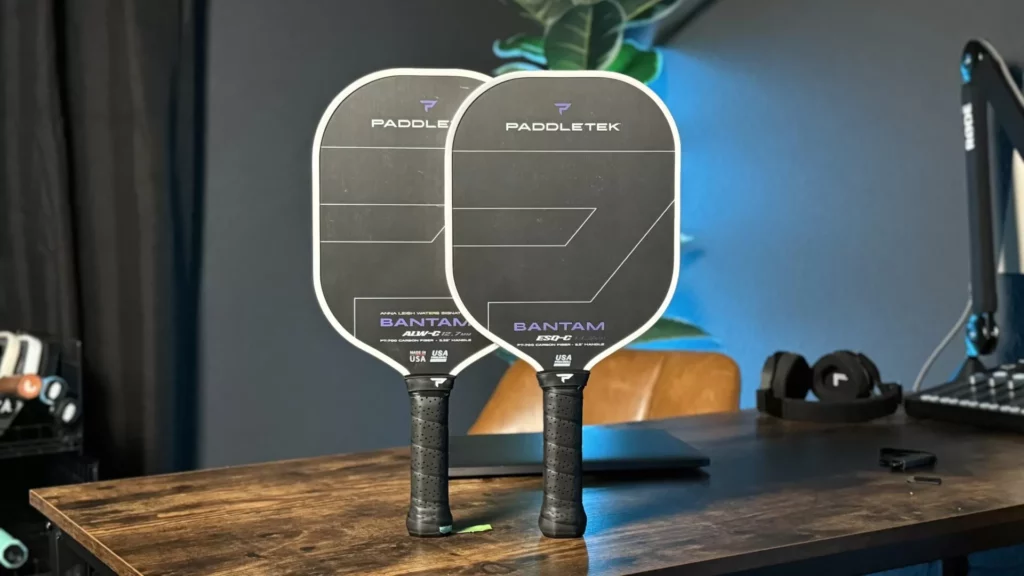
The ESQ-C was released about two weeks after Paddletek updated their similarly shaped Bantam ALW-C handle to be 5.25″ long from 4.8″. The Bantam ALW-C is the paddle women’s world number one player, Anna Leigh Waters, plays and is constructed the exact same way as the Bantam ESQ-C and has a very similar shape.
While there seems to be a lot of overlap and similarities between the two models there are subtle differences. The ALW-C model is a touch longer and narrower along with the .25″ shorter handle. The ALW-C is also a little lighter on average. That being said, when I was switching between both models it was tough to tell a difference in performance. However, because the face is a little bigger on the ESQ-C and the handle length is longer I preferred it over the ALW-C though picking between the two primarily comes down to handle length preference more than anything else.
Now here are some rankings of power, pop, control, forgiveness, and maneuverability for other popular power and all-court paddles in the standard or widebody shape category. Included in the lists are the Paddletek ESQ-Cs, JOOLA Scorpeus 3S 16mm, Ronbus Ripple R2, and the 11SIX24 Monarch All-Court 16mm. If you decide to get any of these paddles, my code 10EFFECT works on all their sites.
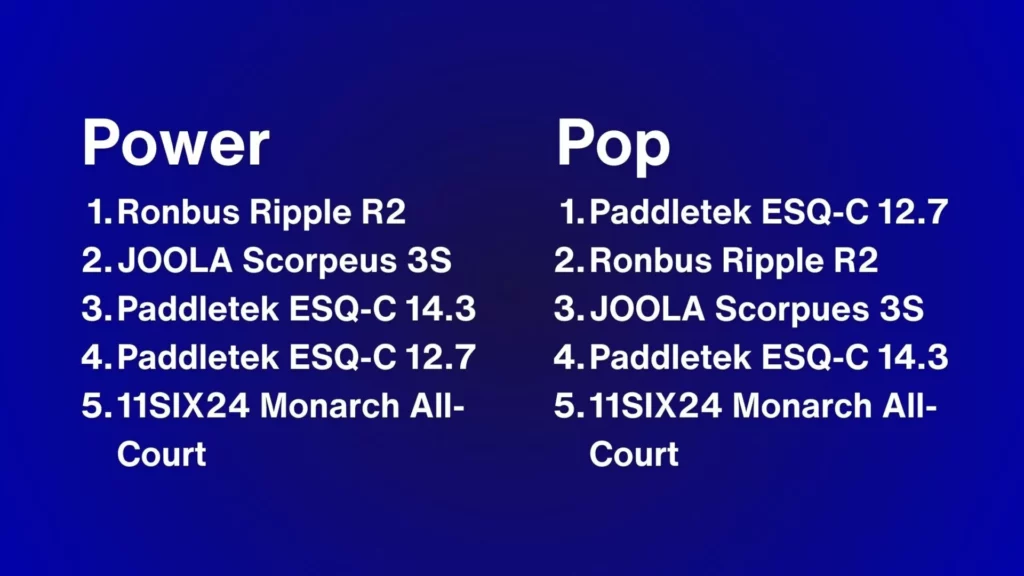
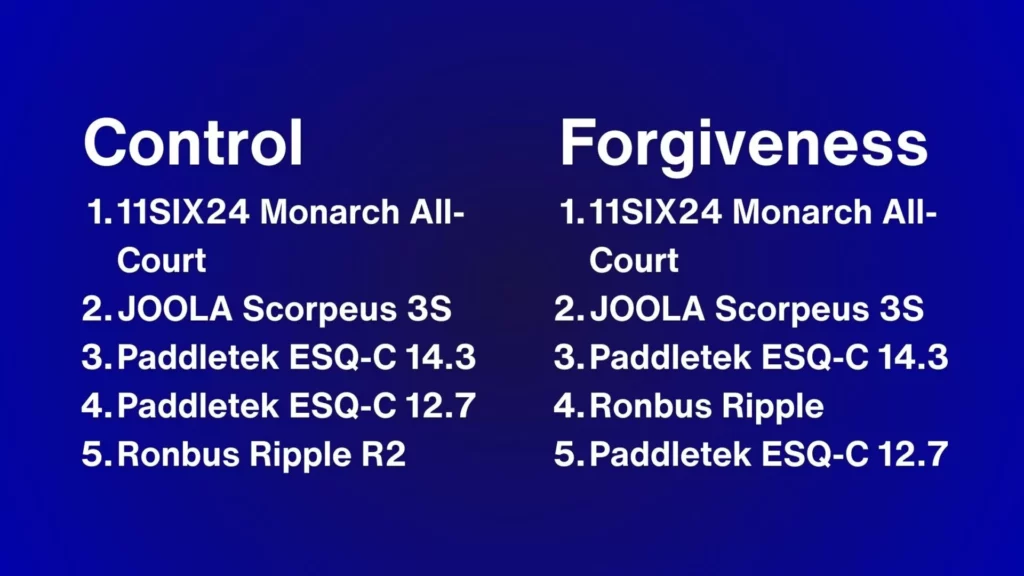
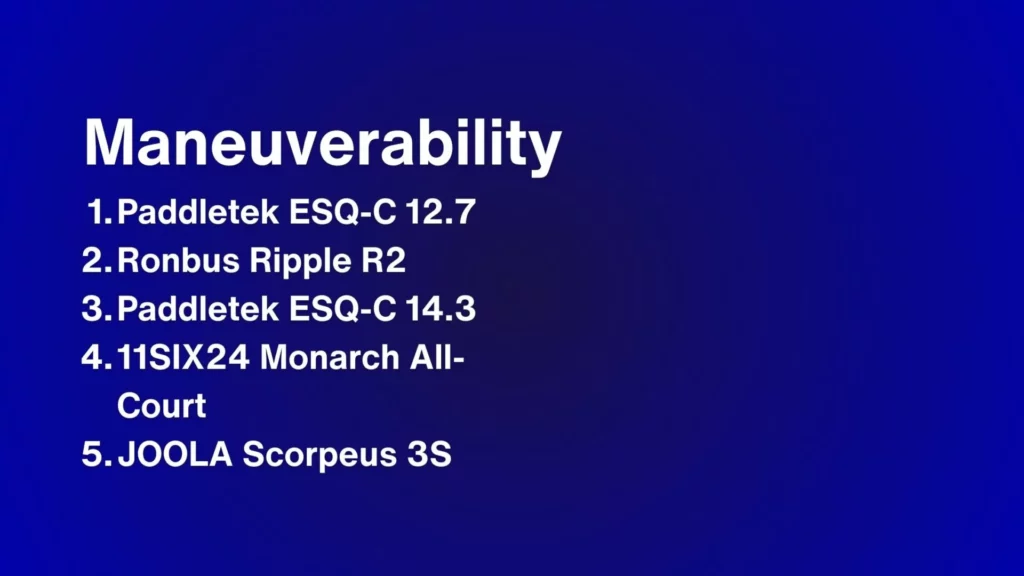
The ESQ-14.3 though is less unique and you can find some cheaper alternatives. The best one that is similar to it is the 11SIX24 Jelly Bean 14mm. It retails for $99 and only cost $90 with the code 10EFFECT on their website. I actually like the handle on the Jelly Bean more too, it’s not as thick. It produces a similar level of power and pop that’s all-court leaning power but achieves it with a little different tech that makes it a little stiffer compared to the 14.3 though it’s not harsh feeling.
I anticipated interest in these paddles, so I played some games to gauge their performance when I first received them. Now I’m having a hard time putting them down and am strongly considering switching to the ESQ-C 12.7 and will be keeping it in my bag for competitive play when I’m not testing other paddles. As a higher level player that doesn’t have that natural transfer of power from paddle to ball, the extra pop on this paddle combined with its excellent maneuverability is a really nice combo to have and has noticeably improved my offensive ability at the net. I’m finding good contact with the ball on counters and am more competitive in hands battles. While my soft game is more challenging with it, I’m controlling the ball better than I was with the Bantam TKO-C models. I’ll keep dialing it in as more time goes.
If you’re like me and benefit from the combination of maneuverability and pop then you’ll like these. The only other paddle that competes as well here is the Ripple R2 though I think the Paddletek is easier to hit drops with so I preferred it over the Ripple R2.
If you’re an intermediate player who wants to add more offensive ability to their game at the net then these paddles are good options. The 14.3 model is more suitable for intermediate to beginner level players as it isn’t quite as poppy and easier to control but still lightweight and more poppy than most other standard and widebody paddles. Then if you’re a more advanced player then I think you go with the 12.7 model to take advantage of the extra pop and weight it to your liking. Generally speaking though these paddles are more demanding so if you don’t have a well developed soft game then the paddles mentioned in my comparison charts above like the 11SIX24 Monarch All Court or the JOOLA 3S Scorpeus would be a better fit.

We’ve categorized paddles into three categories. Control, All-Court, and Power. Paddle categories are determined by Braydon after he hits or reviews the paddle.
A paddle’s weight represents the inherent mass of the paddle as measured on a scale. However, relying solely on this static weight measurement can be misleading when assessing the true perceived heaviness of the paddle. Even if two paddles both clock in at 8 oz, their actual heft in your hand can markedly differ due to variations in weight distribution within the paddle. This is why the static weight should be considered with the swingweight of the paddle. See the definition of swingweight below.
The weight value listed in the database corresponds to the paddle’s weight that I used to gather the swingweight and twistweight measurement. It’s possible that if your paddle has a different static weight than then the swingweight and twistweight may be slightly different.
Swingweight is a measure of the paddle’s resistance to swinging about the end of the handle. The higher the swingweight number the heavier it will feel in your hands. A higher swingweight has more power but is harder to swing, lower swingweight is easier to swing but has less power. Sometimes a faster swing with a lower swingweight can make up for power lost in swingweight. The price paid for that is greater impact shock. Stock swingweights will vary between 100 – 140.
Twistweight is the resistance to rotating around the long axis through the middle of the paddle from butt to tip. The higher the twistweight the more resistance the paddle has to rotating on off center hits. This measurement is closely related to the amount of forgiveness or the size of the sweet spot of the paddle. A higher twistweight indicates a bigger sweet spot. Twistweight numbers range from 5 – 8.
Measuring the revolutions per minute (RPMs) off of a serve you get a number that shows the spin potential of a paddle. Using these RPM measurements I’ve created five buckets that a paddle will fall into indicating its overall spin potential. The five buckets are:
1900 or Higher = Very High
1700 – 1900 = High
1500 – 1700 = Medium
1300 – 1500 = Low
1300 or less = Very Low
You can tell a big difference in the amount of spin a paddle generates when you compare a Very High paddle to a low paddle. But the gains from Medium to High to Very High are marginal. We’ve found that having at least a medium rating is often enough if you’re looking for a good spin paddle. However, if you’re a big hitter then you will benefit more from a high spin paddle to help you keep the ball in play more often.
The power level of a paddle is shown in miles per hour (MPH) after taking ten measurements with a speed gun of hitting a serve as hard as I can. This measurement gives you an idea of how hard you can hit the ball when given the chance to take a full swing. So shots like serves, drives and overheads. The higher the MPH reading the more power you can generate with the paddle.
I also show the percentile ranking of the measurement to give you an idea of how it stacks up against the rest of the paddles in my database.
The pop level of a paddle is shown in miles per hour (MPH) after taking the average of ten speed gun measurements of hitting a punch volley as hard as I can. This measurement gives you an idea of how hard you can hit the ball on shorter swings and gives you an idea of how quickly a ball comes off the face when you apply less force on the ball. So shots volleys, dinks, counters, and resets are all affected by the pop measurement. The higher the pop measurement the stronger your counters will be but it takes more skill to keep the ball from floating or popping up on you when resetting a hard hit ball or when dinking.
I also show the percentile ranking of the measurement to give you an idea of how it stacks up against the rest of the paddles in my database.
The term “forgiveness” pertains to both the size of the sweet spot and the stability of the paddle. A paddle that is more forgiving offers a larger sweet spot, greater stability, and yields more power when hitting off-center shots. On the other hand, a less forgiving paddle has a smaller sweet spot and does not provide as much power when hitting off-center shots.
While there seems to be only benefits of more forgiving paddles, less forgiving paddles are often more maneuverable and is easier to generate more paddle speed.
Looking for the right paddle to fit your game? Take our paddle fitting quiz for three recommendations that will match your style of play.