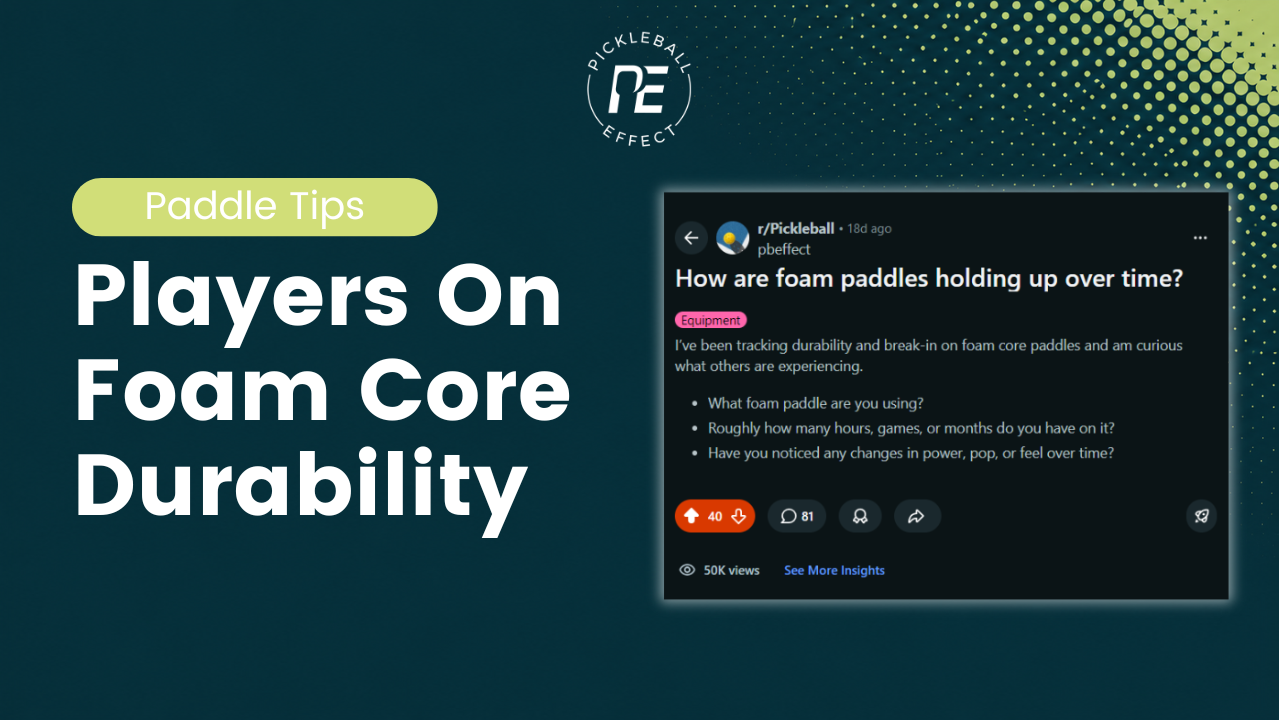
How are foam paddles actually holding up?
That’s the question we asked foam paddle owners in this Reddit discussion. With Gen 4 foam paddles now widely adopted and seeing heavy use, players are finally able to share meaningful long-term durability feedback.
The responses came from players using Ronbus, Spartus, Vatic, Honolulu, Six Zero, and other foam paddles, with reported playtime ranging from a few dozen hours to more than 500.
One finding showed up again and again… the foam core usually wasn’t the first thing wearing out.
Before diving into the findings, Braydon covered this topic in depth on the Pickleball Effect podcast, including how the Reddit responses compared to his own 100-hour Power 2 series testing. The community feedback largely mirrored what he found in the lab.
Affiliate disclosure: If you click the links on the page or use our discount codes, we may earn a small commission at no extra cost to you that supports our testing and reviews.
When foam core paddles launched, the durability claims were hard to ignore. Players had grown used to polymer paddles wearing out faster than they should from core crushing and changes in their performance over time. Foam promised something better.
But at $180–$250 a paddle and no real long-term track record, players had reasonable questions. Would foam cores actually hold up, or would they develop issues of their own? Were the durability claims marketing or reality?
Now that enough players have logged real hours on foam paddles, we’re finally starting to get some answers.
Across a wide range of brands and constructions, players with anywhere from 100 to 500+ hours on their paddles are reporting similar experiences around stable cores, predictable performance, and fewer durability concerns than many expected.
| “Overall, no big changes since the initial break in period.”
| “Feels pretty much the same as when I got it.”
One of the more surprising findings was how little the positive reports clustered around any single brand. Owners of Ronbus, Spartus, Vatic, Honolulu, Six Zero, and other foam paddles were describing how their paddles weren’t breaking down the way many feared they would.
Perhaps most telling, several players contrasted foam paddles with older thermoformed polymer designs and the core-crushing issues that often shortened paddle life.
The surface wears out before the core does.
This was the most agreed-upon finding in the entire discussion, and it changes how players think about foam paddle longevity.
| “Grit wears out first before anything else.”
| “The foam core’s doing good but grit is wearing down.”
The comment that captured the idea best was simple:

Players across multiple brands reported the same pattern. The paddle still felt solid. The core still producing expected performance. But over time the surface gradually lost some of the bite that helps generate spin.
As we’ve been researching durable grit technologies across brands, this stood out to me. If foam cores continue proving durable and surface technologies continue improving, the durability conversation in pickleball may look very different in the near future.
Foam cores are holding up well overall, but they do have their own unique issues.
The most commonly reported structural issue was disbonding, where the facesheet separates from the foam core. Several players mentioned experiencing it, including one who received two replacement paddles that both failed within a short period of play.
As one player put it:
| “Never had an issue with the core but I’ve had paddles disbond.”
A smaller number of players reported dead spots, softened feel, or a noticeable loss of power after months of heavy use.
| “The power and pop became completely dead and the paddle became soft and unusable.”
Edge guard failures also appeared across multiple brands, sometimes triggering warranty claims before the core showed any signs of wear.
Overall, while failures were certainly reported, positive long-term durability experiences outnumbered significant failure reports by roughly 3:1 in the Reddit discussion.
Foam paddles have a more noticeable break-in period than most players expected.

The most common experience players described was a slight settling in feel, a touch less pop than out of the box, with the paddle becoming more consistent and controlled as hours accumulated. Most described it as the paddle finding its range rather than a decrease in performance.
| “Have about 40 hours on my Vapor 2. Took about 20 to break in and has a nice dampened feel now which I love.”
Experiences do vary and one player actually mentioned more power as their paddle opened up over time. But rapid power loss or a paddle that feels dead is not normal. If something feels genuinely off after 30 to 50 hours, it’s worth contacting the manufacturer.
EPP paddles appear to have the more consistently positive durability track record so far.
The most dramatic failures discussed in the thread involved MPP-based paddles, including one player who experienced two back-to-back disbonding failures. At the same time, other MPP owners reported hundreds of hours of play without issues.
| “MPP is more likely to disbond though, also I hear it can be fragile in the cold.”
| “Those fears are over exaggerated.”
| “My Enhance MPP Turbo is doing just fine.”
The takeaway isn’t that one material is definitively better than the other. If anything, the reports suggest construction quality and brand support may matter more than the foam type itself.
For more background on foam core construction, including how EPP and MPP differ and why the market moved away from polymer, this breakdown is a good starting point.
Players expected foam cores to bring more problems. They didn’t.

The biggest durability lesson emerging from the community is that the surface often wears down before the foam core does.
| “I burned through the grit in 3 months. Everything else feels the same.”
Foam paddles still aren’t perfect. Disbonding, edge guard failures, and occasional softening do happen. But the fear that the foam itself would fail doesn’t match what most players seem to be experiencing.
If durability has been your hesitation around foam, the evidence coming back from real players says it probably shouldn’t be.
Based on player reports, foam core paddles are holding up well past 150–200 hours with most players reporting no significant core degradation. Several have logged 200–500+ hours without core issues. For spin-focused players, the more relevant question is how long the surface holds up, not when the core will fail.
Disbonding is when the facesheet separates from the foam core. It’s different from delamination, which is when the face surface itself cracks or comes apart. Disbonding is the most commonly reported structural failure on foam paddles and typically happens at the bond between the carbon facesheet and the foam core.
Yes, and it’s more noticeable than most players expect coming from polymer paddles. The sweet spot opens up and the feel becomes more consistent as hours accumulate.
EPP has the cleaner track record based on community reports, with most players logging 200+ hours without core issues on EPP constructions. MPP results are more variable. Current evidence suggests MPP failures are more construction-dependent than material-dependent. A well-built MPP paddle holds up; a poorly bonded one doesn’t. For a deeper look at the material differences, see Foam vs. Polymer Pickleball Paddles: How We Got Here and Why Foam Is Taking Over.
Based on community reports, foam core paddles are more resistant to core crushing, the failure mode that most commonly ended the life of thermoformed polymer paddles. Foam paddles have their own failure modes, primarily disbonding and surface wear, but the overall picture is more favorable for foam. The data coming back from players with serious hours on these paddles is more positive than most expected going in.
But at the highest levels of the game, most players can already generate enough offense on their own. What separates players is often their ability to reset under pressure, control transition balls, create angles, and apply pressure with spin and placement rather than just raw pace.
That’s why many top players are moving toward more complete all-court setups instead of the most explosive paddles possible.
For developing players, I also think there’s long-term value in learning how to create your own pace and offense rather than relying on the paddle to do most of the work. An all-court paddle can help build a more complete game with better touch and consistency. Then if you eventually move into a power paddle later, it becomes your skill plus the paddle creating offense together, not just the paddle supplying it for you.
Author Profile
Matt started playing pickleball in 2023 and quickly fell in love with the strategy, patterns, and problem-solving parts of the sport. He enjoys following the latest in paddle technology, performance trends, and the pro game. As a type 1 diabetic athlete, he’s especially passionate about the intersection of health and competition, sharing his experiences managing diabetes while competing, training, and navigating everyday life through sports.
Click button to activate sitewide discount.
Affiliate disclosure: If you click the links on the page or use our discount codes, we may earn a small commission at no extra cost to you that supports our testing and reviews.