
Pickleball Apes doesn’t get enough recognition for their original paddle construction and innovation. While many brands are jumping in on the trendy floating foam core design, Pickleball Apes is coming to market with their own tech and I’m glad they did.
They are giving us some variation in foam paddle performance with an activated power paddle profile that we haven’t seen done this well yet. I think this paddle’s performance suits a wider variety of players than the bigger power and pop designs of the full floating foam core design that we are seeing all over the place.
The Charm series plays like an all-court paddle with a power activation element to it. At normal swing speeds it behaves like a predictable all court paddle that helps you control the pace of play better than power paddles. When you swing bigger, you access a clear extra gear of put away power and drive speed. They have good forgiveness levels though nothing special on the S & X and are on the heavier side.
Feel wise, it sits in the dense, plush foam camp. Others in this space are the Vatic Pro V-Sol Powers, CRBN TruFoam, and you could also add in the Honolulu NF series there. Though the Charms are a little firmer at impact vs these which gives them their own personality.
The Charm V widebody is the standout shape of the series for me, with the Charm S hybrid coming in second and the Charm X elongated won’t be as attractive to players unless they prefer extra high swing weights.
(save with code PBEFFECT)
Looking for the right paddle to fit your game? Take our paddle fitting quiz for three recommendations that will match your style of play.
Affiliate disclosure: I was sent this paddle to test, but this review wasn’t paid for or approved by the brand. Everything here reflects my own testing and opinions. If you use the links or my code PBEFFECT, I may earn a small commission at no extra cost to you that supports future reviews.
Pickleball Apes calls the Charm core their Diced Core Technology. This hasn’t been done by another brand and adds a different performance profile with a power activation element that we’ve only seen in one other foam core build.
Inside the Charms you have a full foam core that partly extends from end to end with corner foam inserts and not an eva foam perimeter wrapped around the core. That means:
On top of that, Apes cuts horizontal precision incisions into the core that extend roughly 25 percent of the way into the face on both sides. The idea is to add some flex and power to the paddle.
They sent me two core samples to compare. Like, just the foam itself and not the entire paddle put together. One with those incisions and one without. The one with the incisions bends noticeably easier. The one without is much stiffer. That difference shows up on court almost exactly how you would expect:
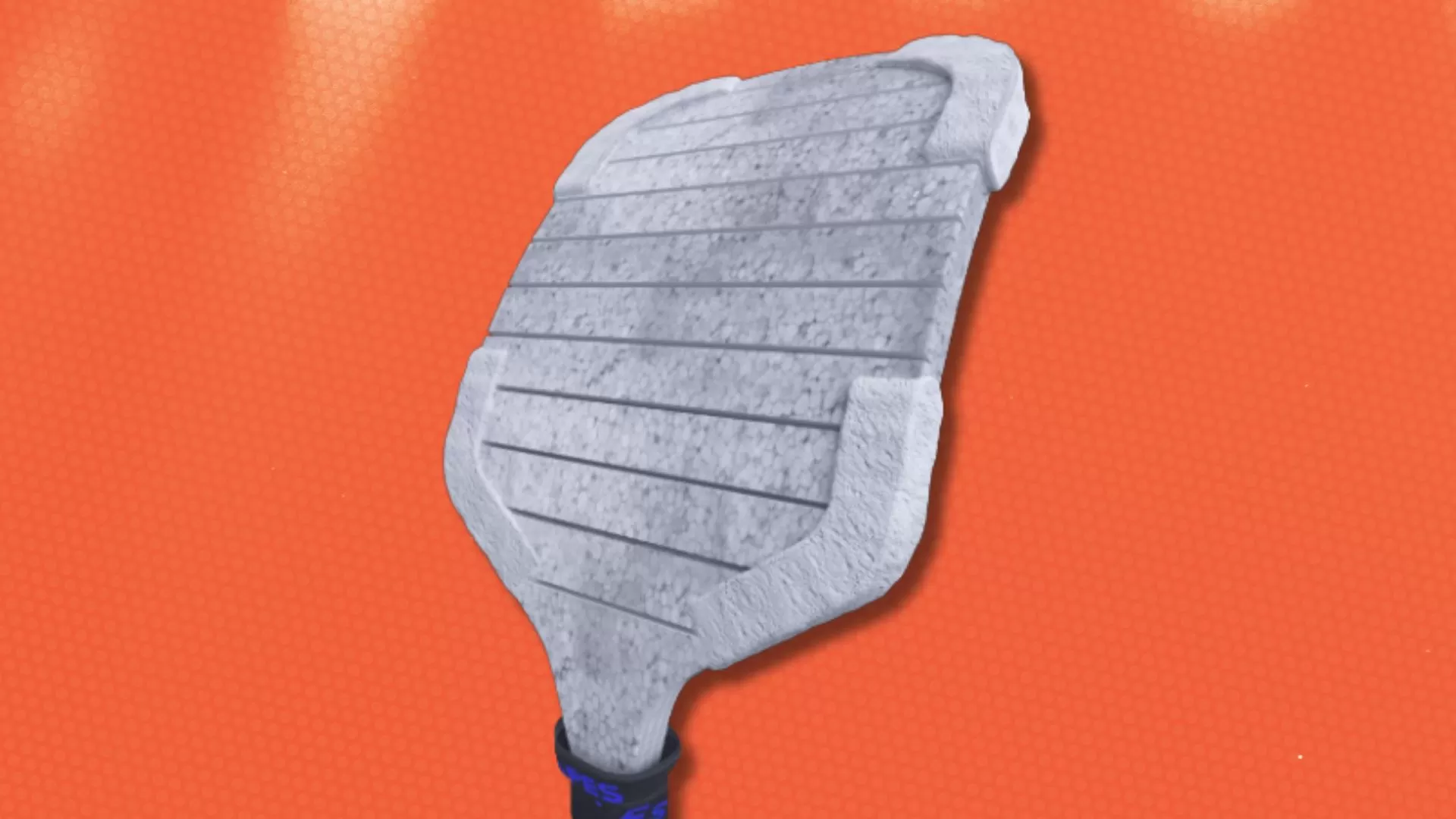
Charm Series Diced Core Example
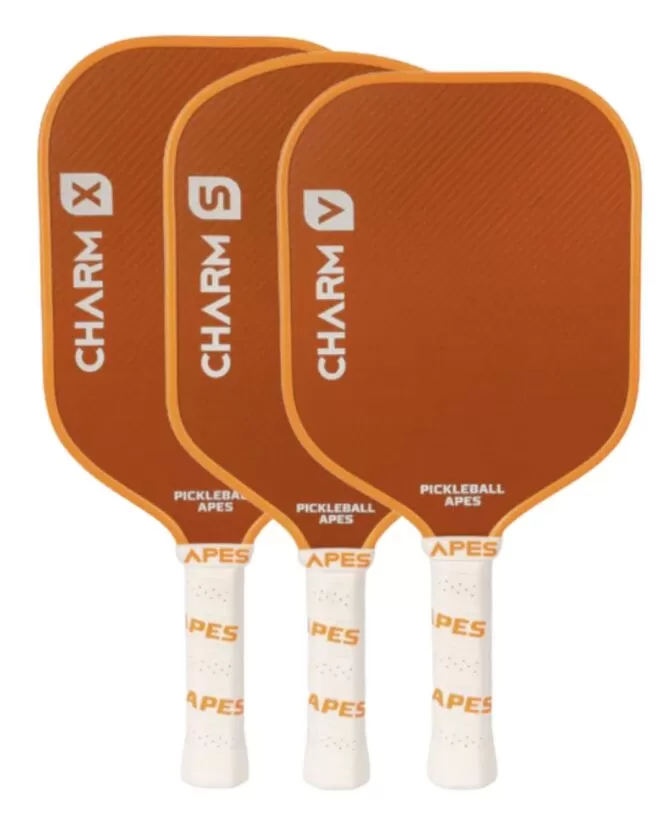
Charm Series
Measurements are from my review units and may vary between paddles.
Save with code PBEFFECT on Pickleball Apes’ website.
The Charm series comes in three shapes that will feel familiar if you have used other Apes paddles:
Charm X – This one sits on the heavy side. If you are already comfortable with swing weights over 120, the X gives you the highest raw power potential in the line, especially up toward the tip where you feel a bit more flex and rebound.
If you are not used to paddles in this swing weight range, it will feel like a lot of paddle to move and can get tiring and potentially cause elbow pain.
Charm S – Swing weight at 115 is a touch high for a hybrid, but still manageable for many players. Interestingly, despite the twist weight number being on the low side for a hybrid, on court it feels more solid than the number suggests.
I played it stock because it already leans a little head heavy and I did not want to push it further in that direction. My only real nitpick is that I wish Apes had made this shape a bit wider. As is, it is shorter like a hybrid, but not as wide as some other hybrids on the market. A little extra width would likely open up the sweet spot even more and give it more of that oversized, forgiving feel.
Charm V – The V is the clear spec winner. The twist weight is numerically huge, right in line with other Apes V shapes, and you feel that as soon as you start hitting. It is very stable on off center contact, yet still quick in the hand thanks to the lighter 111 swing weight.
Across all three shapes, I would categorize the Charms as all court paddles with power paddle level power that can be activated.
The paddle behaves like an all-court paddle on dinks, resets, drops, speed ups and counters but then picks up in power on drives, put aways, and serves.
When you swing harder, especially with the X and S shapes, you get a real bump in power, particularly up toward the tip.
Sometimes with on demand power paddles like these you’ll find the power in counters and speed ups too but that wasn’t the case as much with these. It took a bit more to activate the power. I liked this though. Particularly with speed ups. You could be stretched out laterally looking for a flick and wouldn’t have to be too delicate with it to try and keep it in. It frees you up to be a bit more aggressive and free at the kitchen line where generating ball speed is less important during kitchen exchanges.
You do give up some counter pace though. Counters off speed ups at the net were in the middle ground pace wise. There may be a couple balls a game that come back because of this is all. Though I’m happy with what I can do with the paddle off hard drives. Those still seemed to come off the paddle with good pace.
If you are the type who loves paddles that are always loud and explosive, like a Boomstk or Loco, the Charm series will feel tamer and more controlled. If you want a paddle that behaves itself when you are trying to reset but still lets you finish balls when you have time to swing, this profile makes a lot of sense.
This is where the Charm line really lines up with the needs of a broad group of players.
Because the core is not overly hot at low swing speeds and its power doesn’t come into play without extra effort, the paddles do a good job of:
For a lot of players in that intermediate level range, that is exactly the behavior you want. You get enough offense to end points, but the paddle is not fighting you when you need to slow the ball down or hit something with more precision.
I also like that the paddles have enough liveliness that you don’t have to work overtime just to get the ball over the net. You don’t need to add extra effort on dinks or blocks because the paddle is absorbing too much pace. Use clean mechanics, get the paddle on the ball, and it will respond without you having to force anything.
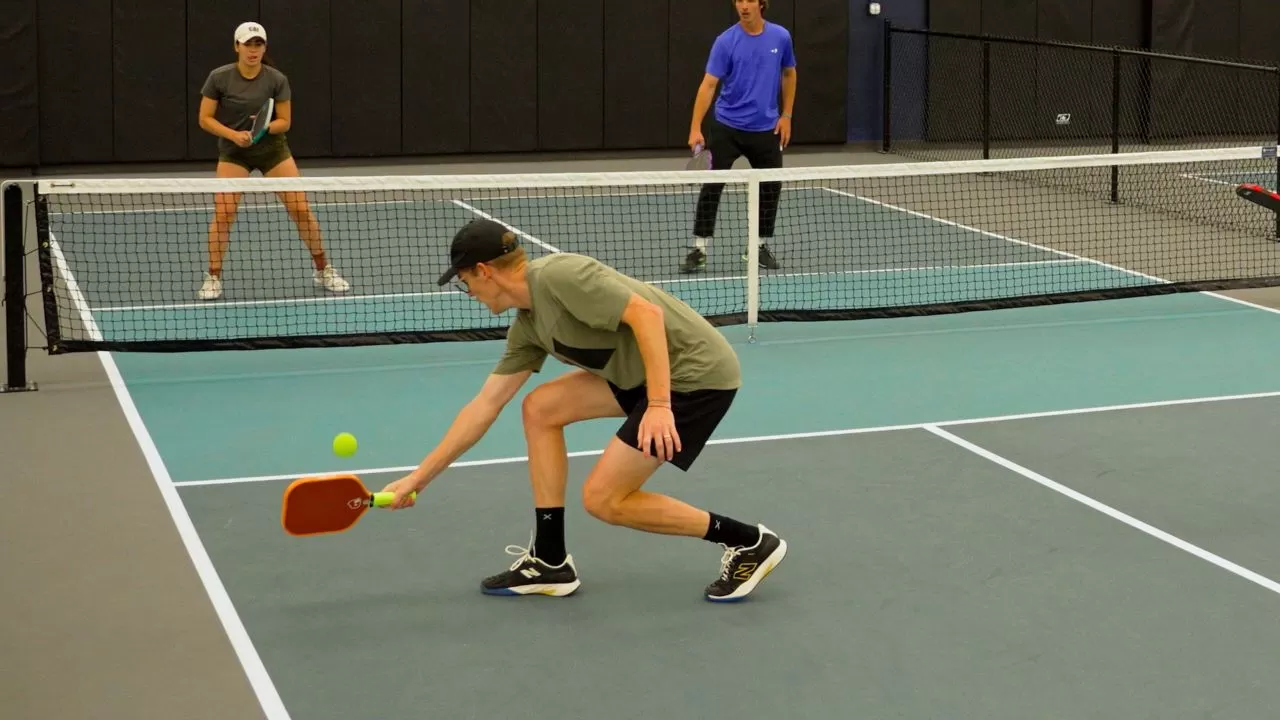
Braydon playing with Charm V
It’s a more plush impact with some feedback to still feel the ball, but not so much noise or vibration that it ever feels harsh.
A few comparisons:
Overall, I would call the line forgiving and well built, with the V shape clearly at the front of the pack in terms of stability and ease of use.
Maneuverability is a lower point for the series. The V is good here though the other two shapes are heavier.
Save on the paddles mentioned above and others with my discount codes found here.
Save with code PBEFFECT on Pickleball Apes’ website
While big, loud power paddles are trendy right now, I would venture to guess that this series would help more people play their best pickleball than those big power paddles. Particularly players in that 3.0 to 4.25 range. The Charm’s activated power profile is a great match for players who need some help from their paddle to keep the ball low and reduce pop ups but still have the pace to finish points.
We’ve categorized paddles into three categories. Control, All-Court, and Power. Paddle categories are determined by Braydon after he hits or reviews the paddle.
A paddle’s weight represents the inherent mass of the paddle as measured on a scale. However, relying solely on this static weight measurement can be misleading when assessing the true perceived heaviness of the paddle. Even if two paddles both clock in at 8 oz, their actual heft in your hand can markedly differ due to variations in weight distribution within the paddle. This is why the static weight should be considered with the swingweight of the paddle. See the definition of swingweight below.
The weight value listed in the database corresponds to the paddle’s weight that I used to gather the swingweight and twistweight measurement. It’s possible that if your paddle has a different static weight than then the swingweight and twistweight may be slightly different.
There are three primary shapes a paddle can have which consists of the length and width of the paddle. These three shapes are:
Then there are two less common shapes you’ll see. These are:
When considering the advantages and trade-offs of paddle shapes, it’s important to understand the characteristics of each shape.
It’s interesting to note that advanced players often prefer elongated shapes. On the other hand, players at lower skill levels typically opt for the extra forgiveness offered by standard shaped paddles.
Ultimately, the choice of paddle shape depends on an individual’s playing style, preferences, and skill level. Whether your focus is on reach or forgiveness, understanding the unique benefits and trade-offs of each shape can assist you in selecting the paddle that best suits your game.
Swingweight is a measure of the paddle’s resistance to swinging about the end of the handle. The higher the swingweight number the heavier it will feel in your hands. A higher swingweight has more power but is harder to swing, lower swingweight is easier to swing but has less power. Sometimes a faster swing with a lower swingweight can make up for power lost in swingweight. The price paid for that is greater impact shock. Stock swingweights will vary between 100 – 140.
Twistweight is the resistance to rotating around the long axis through the middle of the paddle from butt to tip. The higher the twistweight the more resistance the paddle has to rotating on off center hits. This measurement is closely related to the amount of forgiveness or the size of the sweet spot of the paddle. A higher twistweight indicates a bigger sweet spot. Twistweight numbers range from 5 – 8.
Measuring the revolutions per minute (RPMs) off of a serve you get a number that shows the spin potential of a paddle. Using these RPM measurements I’ve created five buckets that a paddle will fall into indicating its overall spin potential. The five buckets are:
1900 or Higher = Very High
1700 – 1900 = High
1500 – 1700 = Medium
1300 – 1500 = Low
1300 or less = Very Low
You can tell a big difference in the amount of spin a paddle generates when you compare a Very High paddle to a low paddle. But the gains from Medium to High to Very High are marginal. We’ve found that having at least a medium rating is often enough if you’re looking for a good spin paddle. However, if you’re a big hitter then you will benefit more from a high spin paddle to help you keep the ball in play more often.
The power level of a paddle is shown in miles per hour (MPH) after taking ten measurements with a speed gun of hitting a serve as hard as I can. This measurement gives you an idea of how hard you can hit the ball when given the chance to take a full swing. So shots like serves, drives and overheads. The higher the MPH reading the more power you can generate with the paddle.
I also show the percentile ranking of the measurement to give you an idea of how it stacks up against the rest of the paddles in my database.
The pop level of a paddle is shown in miles per hour (MPH) after taking the average of ten speed gun measurements of hitting a punch volley as hard as I can. This measurement gives you an idea of how hard you can hit the ball on shorter swings and gives you an idea of how quickly a ball comes off the face when you apply less force on the ball. So shots volleys, dinks, counters, and resets are all affected by the pop measurement. The higher the pop measurement the stronger your counters will be but it takes more skill to keep the ball from floating or popping up on you when resetting a hard hit ball or when dinking.
I also show the percentile ranking of the measurement to give you an idea of how it stacks up against the rest of the paddles in my database.

Looking for the right paddle to fit your game? Take our paddle fitting quiz for three recommendations that will match your style of play.