Walk into open play long enough and you’ll see two common mistakes beginners make.
The first group buys a cheap paddle bundle from Amazon that comes with two paddles, four balls, and a carrying bag for $40. Those sets are fine if you’re casually hitting a ball around on vacation, but they often come with dead spots, poor spin, break quickly, and can make learning the game harder than it needs to be.
The second group goes in the complete opposite direction. They see pros using premium paddles from brands like JOOLA and Selkirk, assume expensive means better, and spend $250+ on a paddle built for players far more advanced than they are.
Both paths usually lead to frustration.
Your first paddle should do one thing really well:
Help you learn the game faster and find the joy in pickleball.
That’s the philosophy I use when recommending paddles for beginners.
This article is for new players who are overwhelmed by all the options and technical jargon that come with buying a paddle. I’m going to keep things simple and give you specific recommendations that align with this philosophy, so you don’t have to spend hours researching elsewhere.
There are two beginner paths I recommend depending on your athletic background:
Feel free to jump ahead to the section that fits you best.
This article is for new players who are overwhelmed by all the options and technical jargon that come with buying a paddle.
Your first paddle should do one thing really well:
Help you learn the game faster and find the joy in pickleball.
That’s the philosophy I use when recommending paddles for beginners.
I’m going to keep things simple and give you specific recommendations that align with this philosophy, so you don’t have to spend hours researching elsewhere.
There are two beginner paths I recommend depending on your athletic background:
Feel free to jump ahead to the section that fits you best.
Looking for the right paddle to fit your game? Take our paddle fitting quiz for three recommendations that will match your style of play.
This path is for players who are new to paddle sports and starting from scratch.
Maybe you’ve never played tennis, ping pong, baseball, hockey, or any sport that required a lot of hand-eye coordination. Maybe pickleball is simply something your spouse, coworkers, or friends talked you into trying.
You might be the person showing up to open play with a cheap Amazon starter set while everyone around you seems to have expensive JOOLA and Selkirk paddles and you’re wondering if you need one too.
Or maybe you’re still figuring out if pickleball is going to become your new obsession or just a fun way to stay active a few times per week.
Right now, you need a paddle that helps you build confidence, keeps more balls in play, and doesn’t punish you as you develop your skill set.
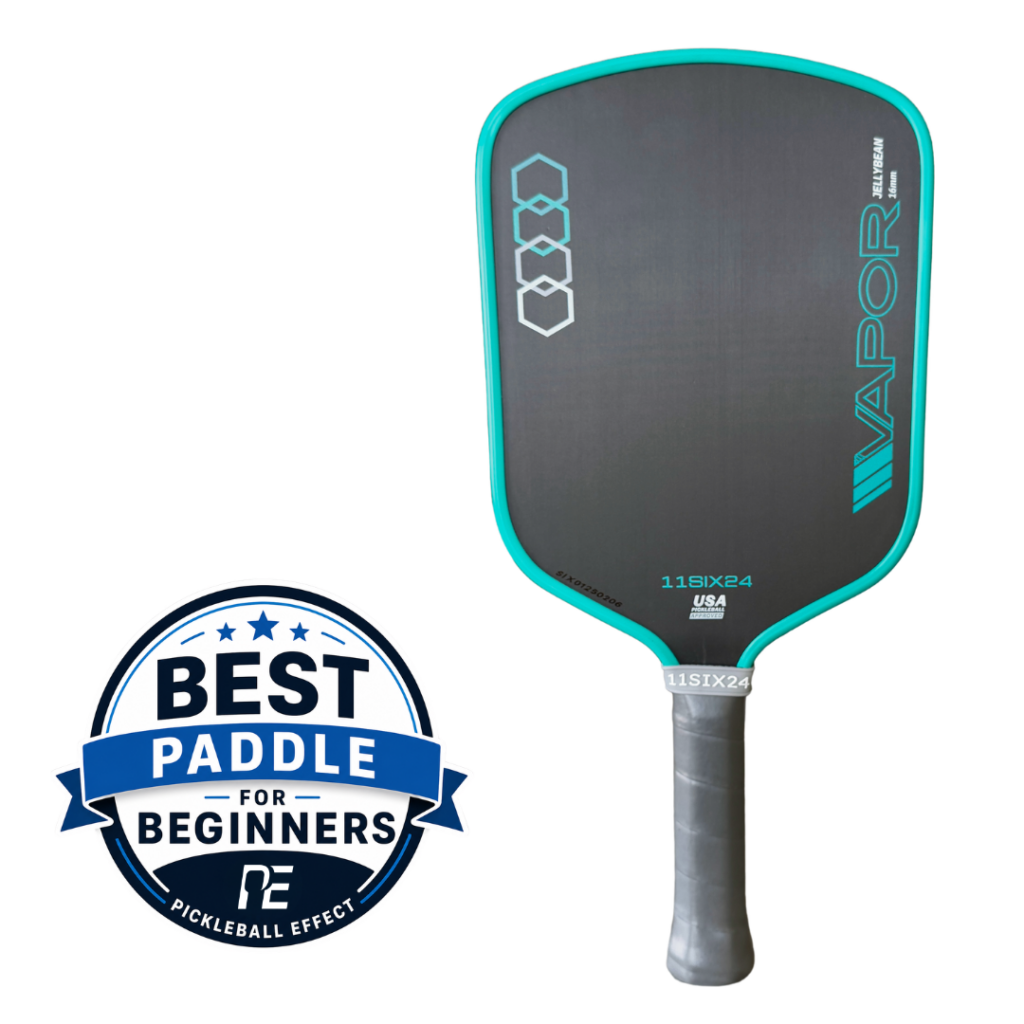
A modern control paddle in a hybrid shape.
This gives you a strong balance of forgiveness, reach, and control with just enough offensive upside.
My top recommendation: 11SIX24 Vapor Jelly Bean
Price: $99.99 (Use code PBEFFECT for $10 off — final price $89.99)
This paddle checks every box players in this group need.
It has a large sweet spot, is light weight and easy to maneuver, good spin, and some reach to help you cover the court.
Some control paddles can feel so muted that players quickly outgrow them. This one gives you a healthier middle ground.
Most importantly, it gives you room to make mistakes without punishing you and will not limit you as you play like an Amazon set would.
And the price is another big reason I like it. You can spend well over $200 on control paddles from larger brands, but you’re not getting better performance than what this paddle offers.
And yes, the name is a little funny.
But 11SIX24 is a legitimate and well-respected brand with pros using their paddles on the PPA Tour. This isn’t some random Amazon paddle you’ll feel the need to replace in one month.
Save with code PBEFFECT
This path is for players who already have strong athletic instincts or experience in sports that developed hand-eye coordination, footwork, and can quickly understand strategy.
Maybe you played tennis, table tennis, baseball, hockey, golf, squash, badminton, basketball, soccer, or another sport where timing, movement, and competitive instincts came naturally.
Or maybe you’ve only played pickleball a handful of times and already feel yourself progressing faster than most beginners at open play.
If that sounds like you, you’ll likely improve faster than the average beginner. You still need a paddle that helps you learn the nuances of the game, but a pure control paddle will feel limiting sooner than later. You want something that can grow with you without jumping straight into an overly aggressive power paddle that can slow your development.
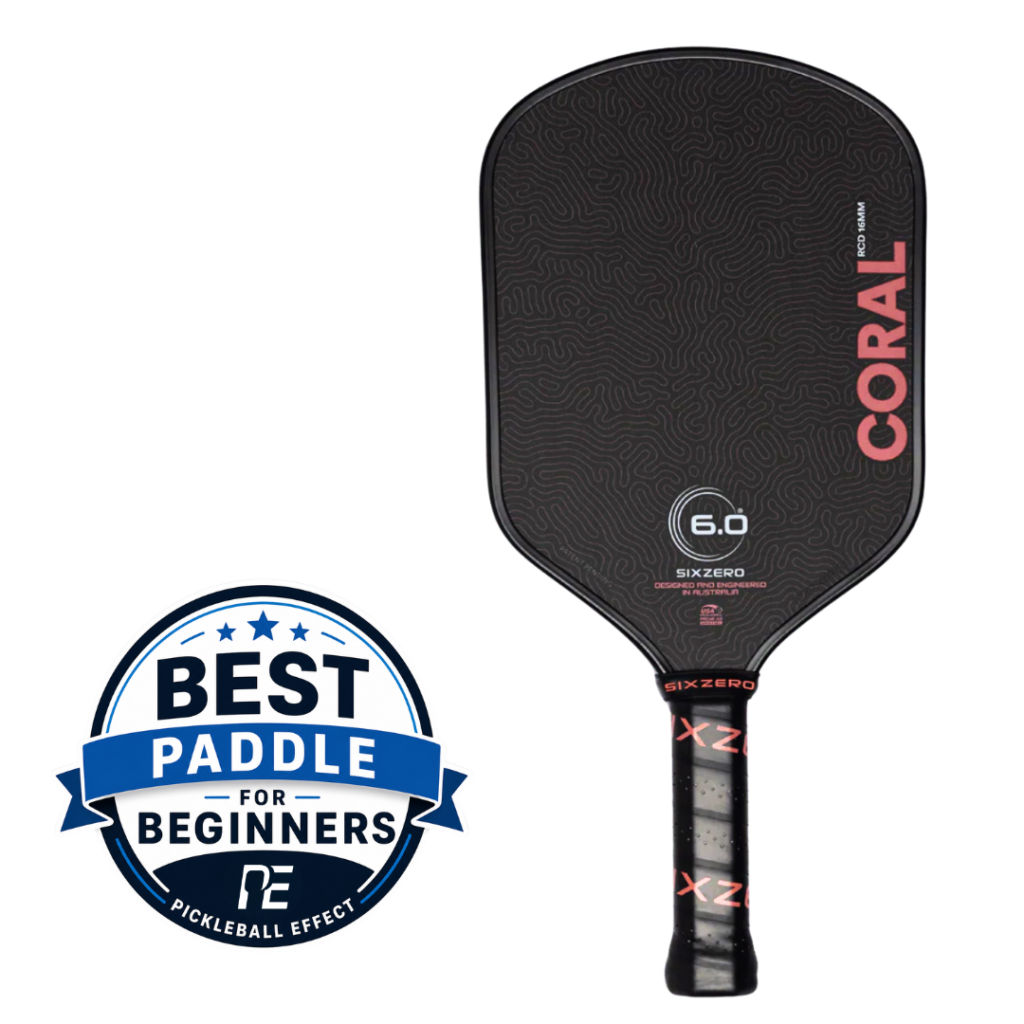
A modern all-court paddle in a hybrid shape.
These paddles give you the forgiveness to learn now and the offense to grow into as you improve quickly.
My top recommendation: Six Zero Coral Hybrid
Price: $200 (Use code PBEFFECT for 10% off — final price $180)
This is one of the best all-court paddles, especially for players who know they’re going to improve quickly.
The Coral Hybrid gives you more offensive upside than a pure control paddle, but it doesn’t cross into overly reactive power paddle territory that can frustrate newer players.
It offers a great mix of pop, put-away power, forgiveness, and consistency while still feeling manageable to control in the soft game.
That balance matters for this group because you may outgrow a beginner-focused control paddle fairly quickly, but you still need something that helps you develop strong fundamentals.
I also like the hybrid shape here because it gives you a healthy mix of reach, forgiveness, and maneuverability without forcing you into something overly specialized.
The biggest reason I recommend this paddle is simple: it can realistically stay in your bag for a long time.
You can buy this as a beginner, improve quickly, and still feel good about using it as your game levels up. That makes it a much smarter investment than buying a pure control paddle now and replacing it a few months later, or jumping straight into a high-powered paddle that can stunt your improvement.
Save with code PBEFFECT
After fitting hundreds of players over the years, I’ve seen these same questions come up again and again from people buying their first performance paddle, and they show up all over Reddit, Facebook groups, and pickleball forums too:
Should I get a control paddle or power paddle?
Should I buy a 14mm or 16mm paddle?
Should I get an elongated paddle for more reach?
Do I need to spend $250?
Will I outgrow my first paddle quickly?
They’re fair questions.
The problem is most beginners are trying to optimize for things they haven’t earned enough court experience to understand yet.
Right now, your biggest challenge isn’t maximizing power or obsessing over paddle specs .
It’s learning how to:
And this is exactly why I made my recommendations so specific.
I already did the work of filtering through things like shape, swing weight, balance point, forgiveness, power level, feel profile, and price to find paddles that give beginners the best chance to succeed.
In other words, you don’t need to understand every paddle spec right now because I’ve already filtered that for you.
These paddles have the right mix of power, forgiveness, and long-term value for where your game is today. As your skills improve, you’ll naturally learn more about paddle specs and start to understand the specific feel, performance traits, and nuances you want from future paddles.
Save with code PBEFFECT
Let’s break down this questions:
“Should I get an elongated paddle or a widebody paddle?”
And
“What does 14mm vs 16mm even mean?”
This is where beginners start falling into analysis paralysis.
You do not need to spend hours researching:
Those things absolutely matter later.
They just don’t matter enough right now to justify overwhelming yourself.
That’s why I recommend hybrid paddles for most beginners.
They’re the middle ground and offer the most versatility when you don’t know your preferences yet.
You get:
And on thickness:
Players just starting are better off with 16mm paddles because they offer bigger sweet spots than thinner 14mm builds so you can keep the rally going when you don’t strike the ball dead center. In fact, I think 16mm paddles are best for all levels of players. It’s uncommon that I recommend a 14mm paddle.
Simple and complete beats specialized when you’re learning.
Another massive beginner question:
“Is it worth spending money on a better paddle?”
The answer is yes, but only to a point.
You should absolutely upgrade from a cheap Amazon starter set. Spend enough to get quality, but you do not need to spend $250 to buy status.
Plus, this is your first real paddle, you’ll likely move on to your second much faster as your skills and preferences develop than you will to your third or fourth.
The sweet spot for most beginners today is roughly $90–$180.
That price range now gives you access to:
This didn’t exist a few years ago.
There are now direct-to-consumer brands making excellent paddles that outperform some legacy brands charging significantly more.
Spend enough to get quality.
Don’t overspend trying to buy status.
A common beginner question is:
“Should I get a power paddle so I can hit harder?”
For most beginners, the answer is no.
Many beginners fall into this trap because a lot of new paddle releases are power-focused. You see them all over the courts, and yes, it’s fun to hit a hard winner. But when you’re still developing, your technique isn’t consistent. A highly reactive power paddle ends up amplifying those inconsistencies, leading to:
A more controlled or all-court paddle gives you margin for error so you can keep more balls in play and build confidence. While you’re friends are struggling to tame their power paddles, you’ll be wiping them all over the court with a paddle that fits your needs and skills better.
And at beginner levels, you don’t need a ton of power to win points. Most rallies are decided by keeping the ball in play, fewer unforced errors and decision-making, not how hard you hit the ball.
There’s also a development piece. Relying on power too early can lead to poor shot selection and bad habits.
It’s much easier to add power later than it is to take it away and try to learn touch shots.
Start with control, learn the game, and layer in more power as your skills improve.
This is one of the biggest beginner traps.
You watch pro pickleball and think:
“Ben Johns uses JOOLA, should I buy that?”
“That Selkirk paddle looks cool.”
“That’s what the pros use, so it must be the best.”
That’s not how paddle fitting works.
Pros have:
Most beginners would play worse with many pro paddles.
Buying a pro paddle too early is like buying a race car before learning how to drive.
This is where things get more fun.
And this is another question I see constantly online:
“I’ve improved…what paddle should I get next?”
By the time you outgrow your first paddle, you’ll actually understand your preferences.
You may realize:
And now paddle terminology will make far more sense because you’ll have real court experience.
Things like:
At this point, your second paddle becomes far more personalized.
Your first paddle helps you learn pickleball.
Your next paddle helps you refine your identity as a player.
That’s when it makes sense to explore more specialized gear.
For helpful resources check out my always up to date best paddles list and comprehensive paddle database.
Reviewer Profile
Braydon Unsicker is the founder of Pickleball Effect and has been reviewing pickleball gear since 2020. He’s known for independent, data-backed paddle reviews and hands-on testing that help players cut through marketing claims and make smarter equipment decisions.

Click button to activate sitewide discount.
Looking for the right paddle to fit your game? Take our paddle fitting quiz for three recommendations that will match your style of play.