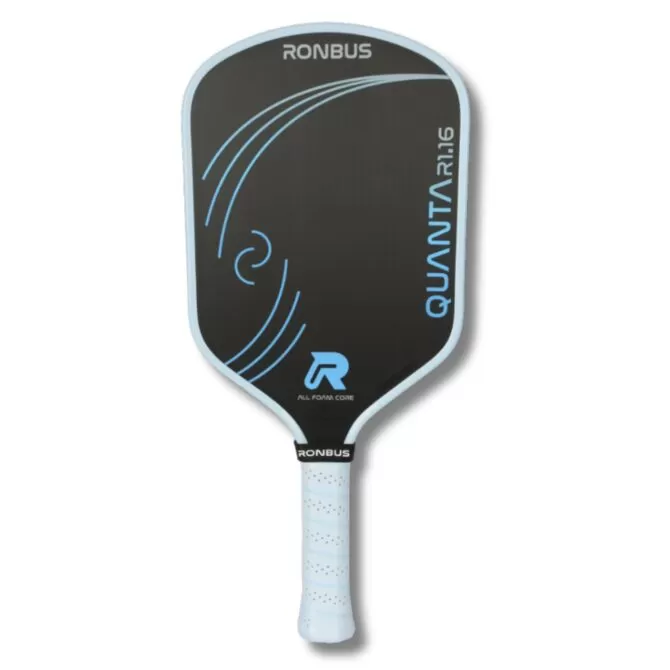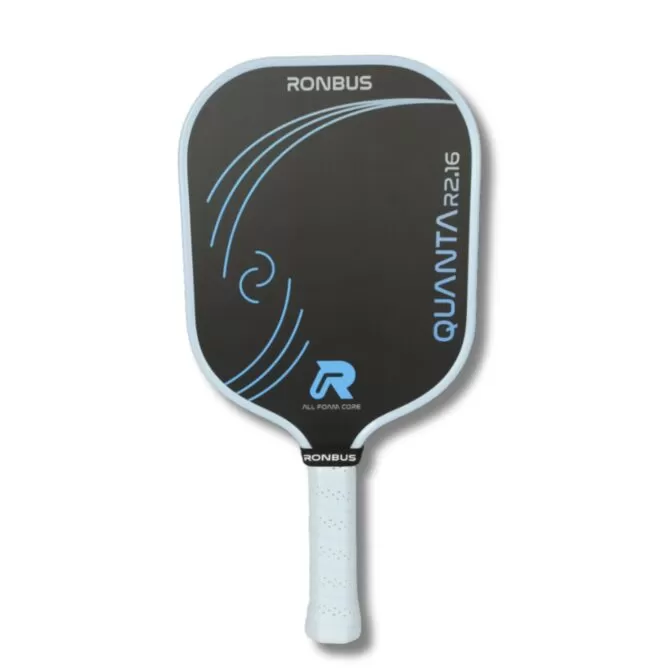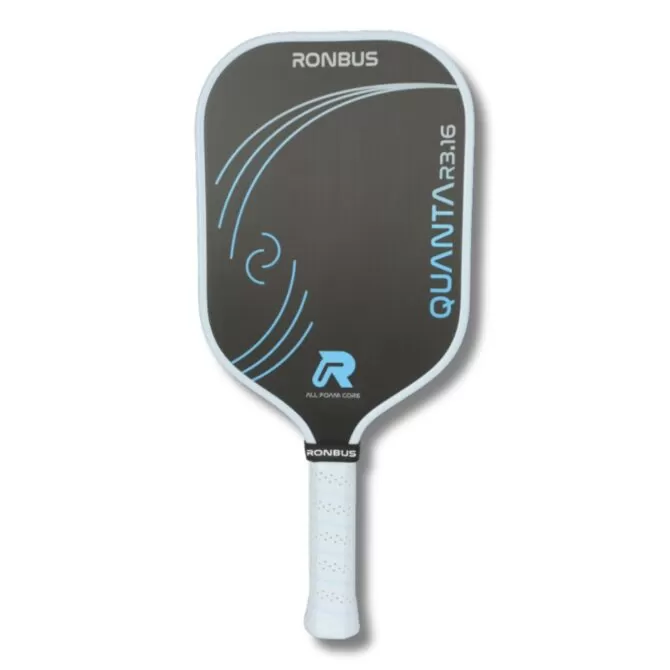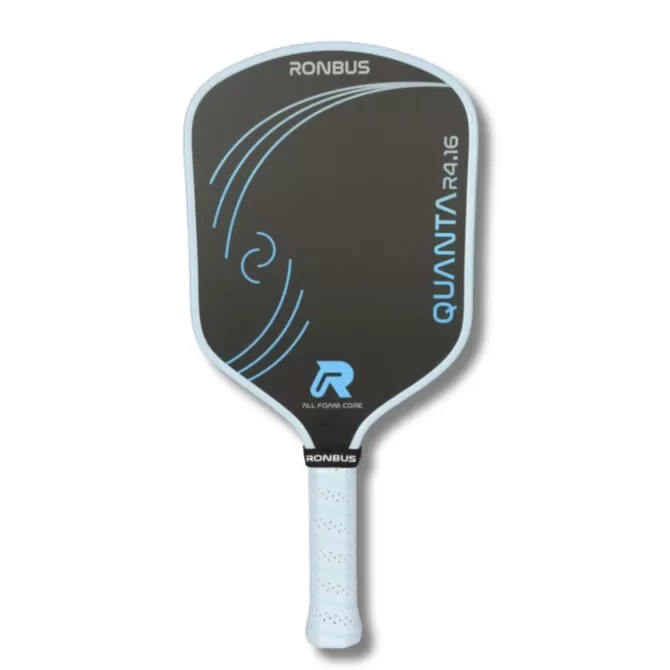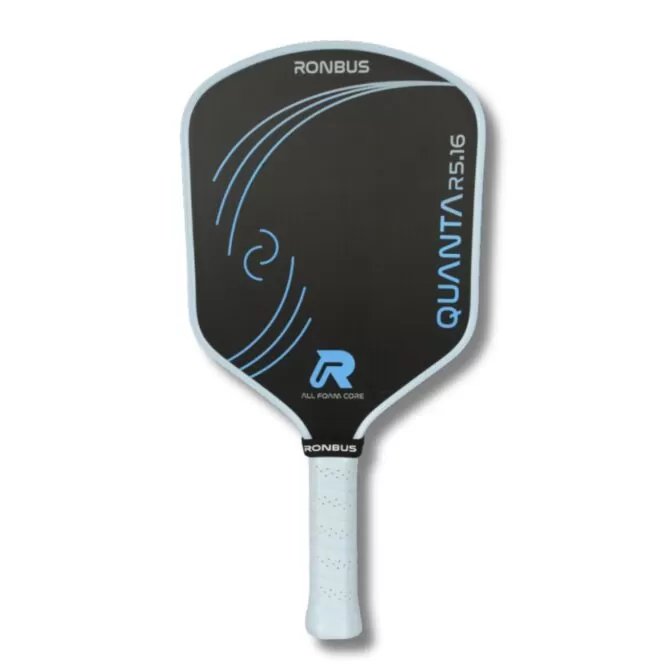

Ronbus just reset the value bar. The Quanta Series arrives as a true power Gen 4 full-foam line that plays in the same arena as premium power paddles yet rings in around $99 after discount. No honeycomb anywhere, no core-crush drama, and performance that, once tuned, lands in legit power paddle territory and is the first budget paddle that is a real alternative to the power category leaders.
Use code PBEFFECT for $20 off your paddle purchase.
Looking for the right paddle to fit your game? Take our paddle fitting quiz for three recommendations that will match your style of play.

This is the third paddle to feature a foam construction that I think will become very common: a solid EPP core surrounded by a ring of EVA foam, also seen in the Selkirk Boomstik and Bread & Butter Locos. While each has its own nuances, the x-rays highlight just how alike the designs are. On court, they share common traits as well. Very powerful, loud, and marked by a stiffer, more hollow feel. I will break down the differences in the comparison section below but they are all very good and are the top of the power category in performance in my opinion.
The numbers are low across the board on these. Which makes these paddles light, quick, and easy to swing but also less stable and lacking plow-through until weight is added. For players who like to customize by applying tungsten tape, that low starting point is a huge advantage because you can dial in the stability and balance to your liking. But if you don’t like to customize and tinker with paddle setups then these may not be for you.
| Metric | R1 | R2 | R3 | R4 | R5 |
|---|---|---|---|---|---|
Shape | Elongated, curve top | Widebody, square top | Elongated, square top | Hybrid, curve top | Widebody, curve top |
Static Weight | 7.65oz | 7.68oz | 7.69 | 7.7 | 7.7 |
Swingweight | 107 | 103 | 113 | 105 | 103 |
Twistweight | 5.6 | 6.25 | 5.64 | 5.9 | 6.15 |
Core | Gen 4 EPP Floating Core | Gen 4 EPP Floating Core | Gen 4 EPP Floating Core | Gen 4 EPP Floating Core | Gen 4 EPP Floating Core |
Handle Length | 5.5 | 5.5 | 5.5 | 5.5 | 5.5 |
Grip Size | 4.13 | 4.13 | 4.13 | 4.13 | 4.13 |
Out of the box, the Quanta sits in the middle of the power class. Drive speed is good, pop is present but not overwhelming. Add perimeter weight and it jumps a tier: the sweet spot firms up, contact gets “thuddier,” and ball speed off the face starts to flirt with upper-tier power paddles. Blind sound/feel tests on a weighted Quanta were surprisingly close to a Selkirk Boomstik.
Energy in equals energy out. The response is linear, which makes targeting drops and dinks straightforward. Resets, especially out of the air, benefit from the even face feel. Weighting improves stability at contact and tightens dispersion. The pop level is on the higher end so the paddle doesn’t do much work for you here but if you can keep your strokes tight and have some sense of your own soft game then you can control these as well as any other power paddles in the high power class.
Feel wise it has a stiffer, hollower feel very similar to a gen 3 style paddle that isn’t full foam. So if you come from that style of paddle then this will feel familiar. However, if you prefer softer or a more dense impact feel then this isn’t that.
Use code PBEFFECT for $20 off your paddle purchase.
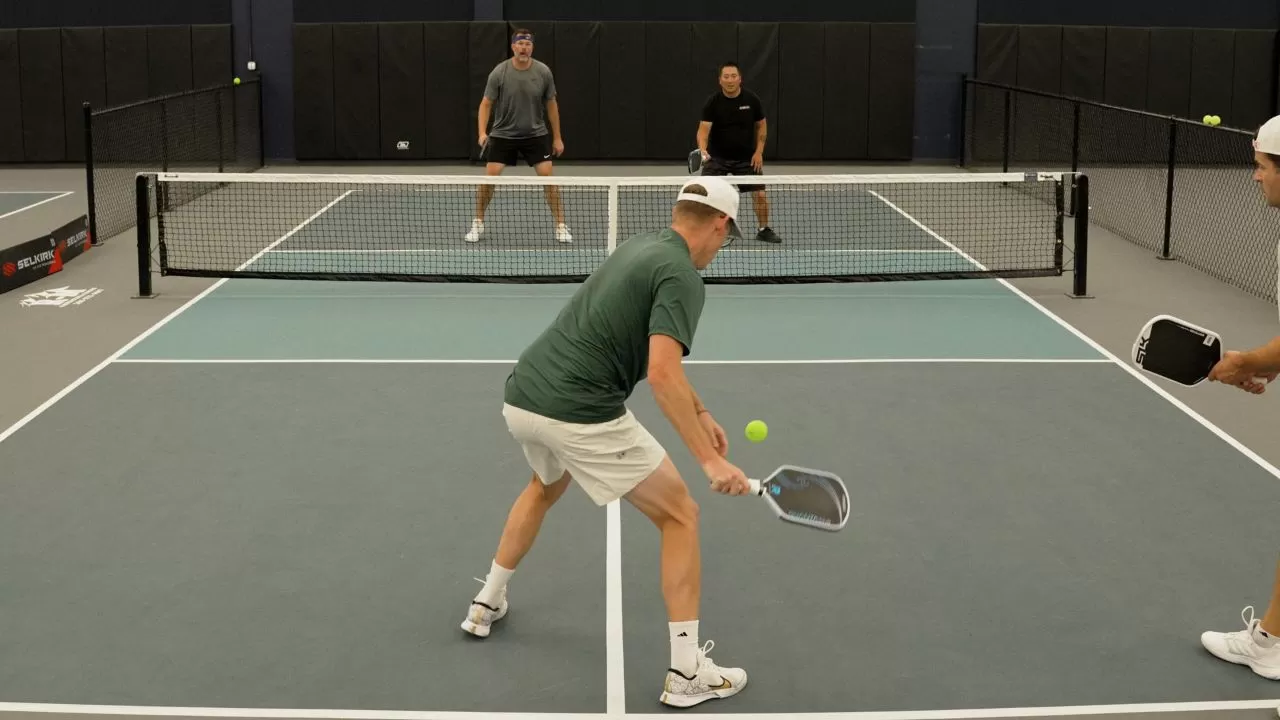
Braydon playing Ronbus Quanta
This is the Quanta’s stock superpower. Very low swingweights make hand battles and rapid counters feel easy. Even after adding 12+ grams total, it stays quicker than most peers.
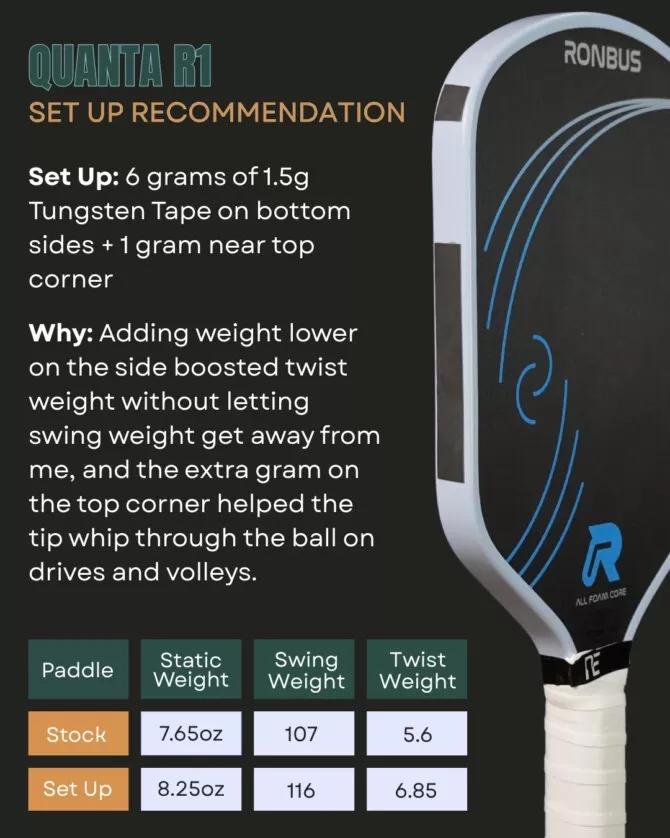
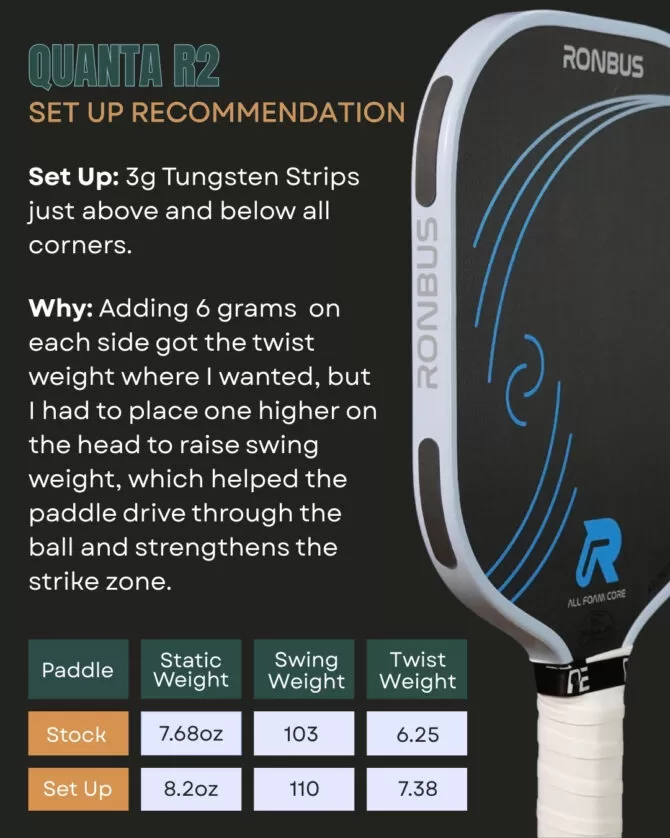
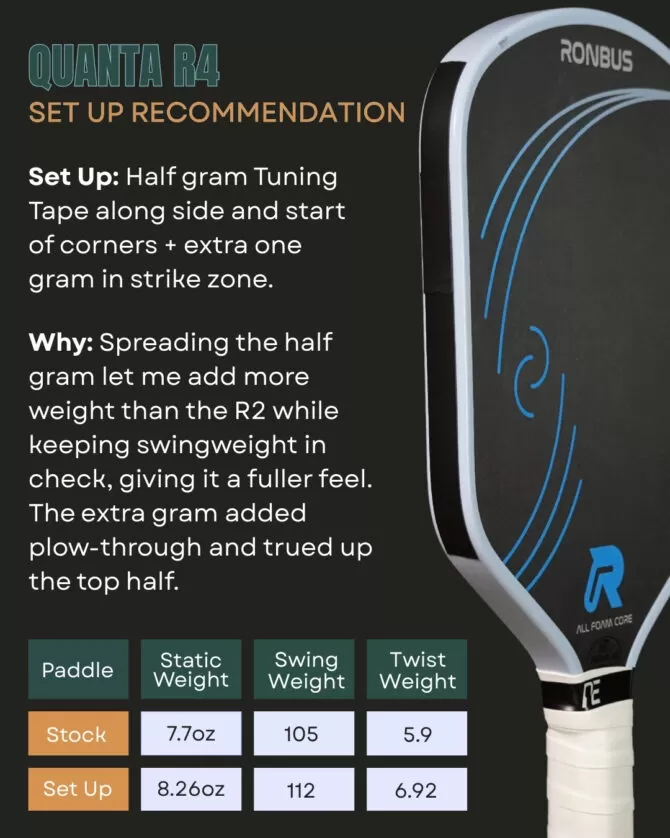
These paddles are designed to be tuned. I liked the R1, R2, and the R4 the most and think they offer the best play so here are my recommended setups for those paddles if you need a place to start. I’ve only weighted these up to 8.2–8.3 ounces including tape and overgrips, so they’re still not heavy. But the twistweight and swingweight numbers are stronger than what you normally see on stock paddles around 8 ounces that get customized up to the same range.
You can purchase the weighted tape I used for these set ups here:
The Ronbus Quanta is the new value benchmark in Gen 4 foam and in the power category. Stock, it is fast and playable. Weighted, it becomes a genuine power threat with a satisfying thud and a much bigger strike zone. Given the performance ceiling and the price, this is an easy recommendation.
Who This Paddle Is For:
Who This Paddle Is Not For:
Use code PBEFFECT for $20 off your paddle purchase.

We’ve categorized paddles into three categories. Control, All-Court, and Power. Paddle categories are determined by Braydon after he hits or reviews the paddle.
A paddle’s weight represents the inherent mass of the paddle as measured on a scale. However, relying solely on this static weight measurement can be misleading when assessing the true perceived heaviness of the paddle. Even if two paddles both clock in at 8 oz, their actual heft in your hand can markedly differ due to variations in weight distribution within the paddle. This is why the static weight should be considered with the swingweight of the paddle. See the definition of swingweight below.
The weight value listed in the database corresponds to the paddle’s weight that I used to gather the swingweight and twistweight measurement. It’s possible that if your paddle has a different static weight than then the swingweight and twistweight may be slightly different.
Swingweight is a measure of the paddle’s resistance to swinging about the end of the handle. The higher the swingweight number the heavier it will feel in your hands. A higher swingweight has more power but is harder to swing, lower swingweight is easier to swing but has less power. Sometimes a faster swing with a lower swingweight can make up for power lost in swingweight. The price paid for that is greater impact shock. Stock swingweights will vary between 100 – 140.
Twistweight is the resistance to rotating around the long axis through the middle of the paddle from butt to tip. The higher the twistweight the more resistance the paddle has to rotating on off center hits. This measurement is closely related to the amount of forgiveness or the size of the sweet spot of the paddle. A higher twistweight indicates a bigger sweet spot. Twistweight numbers range from 5 – 8.
Measuring the revolutions per minute (RPMs) off of a serve you get a number that shows the spin potential of a paddle. Using these RPM measurements I’ve created five buckets that a paddle will fall into indicating its overall spin potential. The five buckets are:
1900 or Higher = Very High
1700 – 1900 = High
1500 – 1700 = Medium
1300 – 1500 = Low
1300 or less = Very Low
You can tell a big difference in the amount of spin a paddle generates when you compare a Very High paddle to a low paddle. But the gains from Medium to High to Very High are marginal. We’ve found that having at least a medium rating is often enough if you’re looking for a good spin paddle. However, if you’re a big hitter then you will benefit more from a high spin paddle to help you keep the ball in play more often.
The power level of a paddle is shown in miles per hour (MPH) after taking ten measurements with a speed gun of hitting a serve as hard as I can. This measurement gives you an idea of how hard you can hit the ball when given the chance to take a full swing. So shots like serves, drives and overheads. The higher the MPH reading the more power you can generate with the paddle.
I also show the percentile ranking of the measurement to give you an idea of how it stacks up against the rest of the paddles in my database.
The pop level of a paddle is shown in miles per hour (MPH) after taking the average of ten speed gun measurements of hitting a punch volley as hard as I can. This measurement gives you an idea of how hard you can hit the ball on shorter swings and gives you an idea of how quickly a ball comes off the face when you apply less force on the ball. So shots volleys, dinks, counters, and resets are all affected by the pop measurement. The higher the pop measurement the stronger your counters will be but it takes more skill to keep the ball from floating or popping up on you when resetting a hard hit ball or when dinking.
I also show the percentile ranking of the measurement to give you an idea of how it stacks up against the rest of the paddles in my database.

Looking for the right paddle to fit your game? Take our paddle fitting quiz for three recommendations that will match your style of play.