
JOOLA introduced the first Gen 3–style paddle back in 2024, and that construction has heavily influenced the direction of the paddle market ever since. While most brands are now pushing toward full foam cores and more durable grit textures, JOOLA’s new Pro V line takes a different route. They’ve added a new throat flex element but kept their Gen 3–style polymer core and traditional peel ply surface, all while raising the price to $300.
So are they making a statement that the current trends are misguided, or are they at risk of falling behind?
I attended JOOLA’s Pro V paddle launch event in Phoenix, Arizona at the end of February 2026 as an unpaid, independent reviewer to better understand the technology and the reasoning behind their decisions. I was sent home with two paddles to test, measure, and evaluate. There’s more going on here than first impressions suggest, but this release will likely raise questions about innovation, value, and whether JOOLA is leading player preference or resisting it.
Looking for the right paddle to fit your game? Take our paddle fitting quiz for recommendations that will match your budget and style of play.
Affiliate disclosure: I was sent this paddle to test, but this review wasn’t paid for or approved by the brand. Everything here reflects my own testing and opinions. If you use click the links on the page or use my code PBEFFECT, I may earn a small commission at no extra cost to you that supports my testing and reviews.
JOOLA is introducing what they call the KineticFrame, a redesigned throat geometry intended to change how the paddle flexes, loads, and releases energy through contact. Outside of that throat redesign, the core construction remains the same as the Pro IV.
These illustrations below show the concept though they are exaggerated.
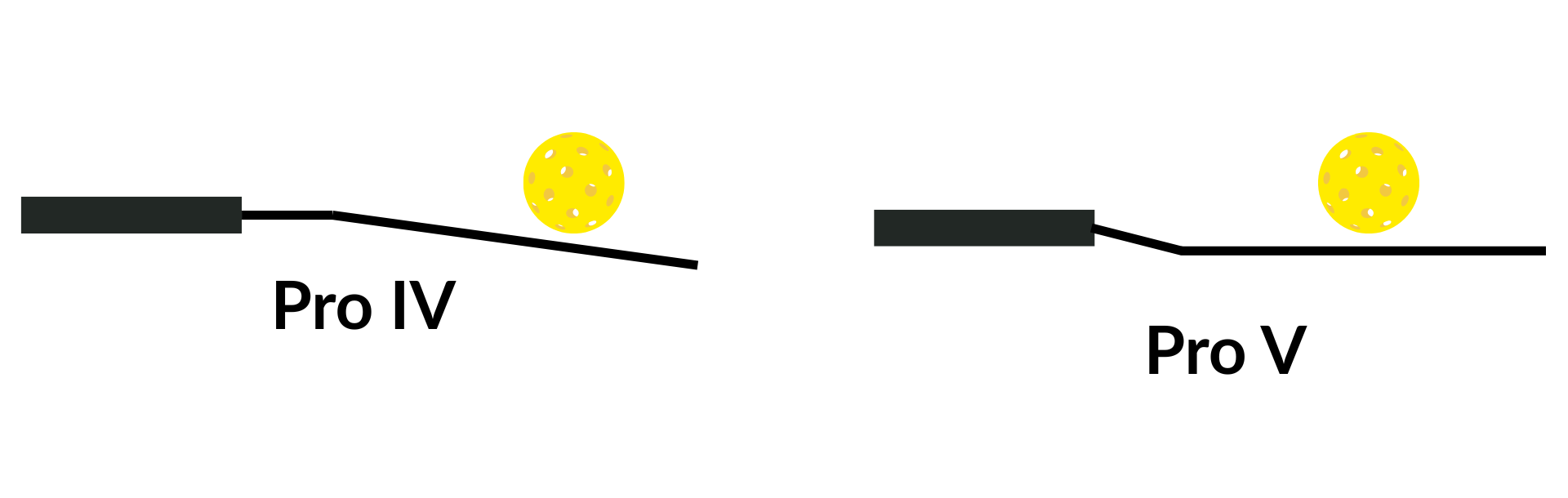
This design is intended to create what JOOLA calls “precise power” by promoting a more consistent launch angle and energy transfer compared to a diving board–style flex pattern. The result is a paddle that requires more deliberate activation to generate power, rather than the more immediate pop and easy offense of the Pro IV. It introduces a distinct performance profile within the Pro lineup, and I personally like how it plays. I’ll break down exactly how that shows up on court in the performance section.

At the event, I asked CEO Richard Lee why JOOLA didn’t move to a full foam core. His response:
“We don’t feel at this point that foam cores are that innovative.”
While I didn’t press further in that moment, conversations throughout the event pointed to a likely philosophy. Ben Johns and several of their pros prefer the feedback and response of a polymer core. This seems to have shaped JOOLA’s belief that polymer delivers the best overall playing experience, even if durability is a tradeoff. Whether the paddle lasts two months or two years, their stance right now is that polymer performs better.
Do I agree with that? Not entirely. There are now multiple foam core constructions that offer excellent feedback and, in some cases, even better ball pocketing than polymer. I’ve also heard from amateur players who still prefer the polymer feel, though that’s getting less common. In my Main Paddle Monitor app, where over 1,600 everyday players have logged their primary paddle, roughly half are using a Gen 4 foam core paddle. That tells me foam isn’t a niche preference anymore.
JOOLA and many other Gen 3–style paddles have drawn scrutiny in the past around long-term core durability. One of the primary ways brands have responded has been by moving toward full foam core constructions, which has become part of their appeal and why many expected JOOLA to follow that path as well.
Instead, JOOLA chose to reinforce the existing structure. They added a layer of carbon fiber between the outer foam layer and the polymer core at the top of the paddle to increase compression strength in the area they’ve identified as the most common point of failure.

Brands like Selkirk and Six Zero have introduced more durable surface textures, and while opinions vary, my testing shows they retain grit longer than traditional peel ply, often referred to as raw carbon fiber.
I expected JOOLA to follow that trend, especially since surface changes typically impact feel less than core changes. This felt like a lower-risk upgrade compared to a full foam redesign. The absence of a new grit was actually more surprising to me than the decision to stick with a polymer core.
When I asked JOOLA’s Product Manager Austin Kim about this, he said:
“We have things in our innovation pipeline about surfaces that need additional validation and testing, but we need to stay within USAP guidelines.”
To me, that suggests something is coming. It just wasn’t ready for this launch.

Construction and price debates aside, this paddle performs well on court. But it’s not a universal upgrade for everyone, especially not automatic for Pro IV users. The players who will love it are the ones who can fully activate what it’s built to do.
There are four key differences I noticed between the Pro V and the Pro IV:
1. Activated Power
The Pro V doesn’t have the instant pop and easy power of the Pro IV. You have to swing with intent to unlock its offense. At the same time, it absorbs pace better on softer shots, making it noticeably less poppy while still capable of good power.
If you struggle to generate your own power, you’ll get more offense from the Pro IV. In my power and pop testing of a new Pro IV and Pro V Perseus, the Pro IV produced higher speeds in both. However, when stronger hitters tested them, they didn’t notice as much difference in drives and counters. What they did notice was improved control on dinks, resets, and thirds.
2. More Consistency
One knock on the Pro IV for some players was occasional “hot” shots where the ball would sling or launch unexpectedly. The Pro V smooths that out. The response feels more predictable whether you’re driving or dropping.
That added consistency allows you to swing more confidently from the baseline and trust the ball trajectory. This is where the KineticFrame shows up the most.
3. Different Impact Feel
The stiff, hollow crack of the Pro IV is gone. The Pro V has a softer, more solid feel at contact with a more muted sound profile. Here’s a feel map showing how I describe the feeling.

4. New Weight Balance
I expected the added carbon reinforcement near the top to make these more head heavy, but the opposite happened. The Pro V swings more head light. This likely ties back to the KineticFrame geometry in the throat.
I view that as a win. The twist weight numbers and sweet spot remain strong despite the lighter swing weight. You can keep it stock for faster hands and maneuverability, or add weighted tape to dial in a more traditional balance without pushing the swing weight too high.
What Does This Mean on Court?
The Pro V allows for a wider variety of shot-making compared to the Pro IV. You can swing a bit more aggressively on dinks to generate spin, find sharper angles from midcourt, and attack with more precision.
What you won’t get is the easier offense of the Pro IV that helps you overpower opponents at times. This paddle amplifies what you bring. It doesn’t manufacture it.
Players with strong mechanics and higher swing speeds, typically 4.5+ level players, will unlock its power ceiling and still view it as a power paddle. Players without a naturally strong drive will likely describe it as an all-court option.
In short, the Pro V rewards athleticism and technique more than the Pro IV does.
Lastly, in terms of spin and forgiveness, my testing showed slightly higher spin numbers for the Pro V. On court, though, it didn’t feel noticeably different from the Pro IV. Both generate strong spin and feel reliable in that department, so you shouldn’t expect a dramatic change there.
JOOLA is planning on dropping the price of their previous Pro IV and 3S models and keeping them around. If you play and love the Pro IV, the Pro V isn’t an automatic switch. I see it more as a different option, not a universal upgrade.
If you can generate your own power, you may appreciate the added consistency and control of the Pro V. But if you rely on your paddle to help you create power, you’re probably better off sticking with the Pro IV or 3S.
JOOLA is replacing the Magnus shape with a new hybrid model called the Kosmos, now used by pro Federico Staksrud. The Pro V line is available in multiple shape options, each offered in both 14mm and 16mm thicknesses. Below are the specifications for the models I was able to test and measure. I don’t have data on every version yet, but here’s what I have so far.
| Paddle | Shape | Thickness (mm) | Handle Length | Weight (oz) | Swing Weight | Twist Weight | Balance Point |
|---|---|---|---|---|---|---|---|
Perseus | Elongated | 16 | 5.5 | 7.95 | 117 | 6.26 | 243 |
Kosmos | Hybrid | 16 | 5.3 | 8 | 114 | 6.68 | 241 |
Hyperion | Elongated | 16 | 5.5 | 8.03 | 115 | 6.17 | 242 |
Hyperion | Elongated | 14 | 5.5 | 7.78 | 111 | 6.02 | 240 |
Scorpeus | Widebody | 16 | 5.25 | 8.13 | 113 | 7.21 | 241 |
Scorpues | Widebody | 14 | 5.25 | 7.8 | 107 | 6.84 | 238 |
Agassi | Elongated | 16 | 5.5 | 8.15 | 118 | 6.25 | 245 |


At $300, the Pro V sits at the top end of the paddle market. That price naturally raises expectations around performance, durability, and long-term value. From a durability standpoint, JOOLA still has some ground to prove, particularly at a price point where players expect their investment to hold up over time.
If you’re a strong, athletic player who can generate your own power and prefer a more controlled, activated response, I can see the value. The added consistency and refined weight balance will appeal to that segment. For players who can fully unlock what this paddle is designed to do, it offers a distinct and polished performance profile within JOOLA’s lineup.
For the average player, though, where the Pro V behaves more like a typical all-court paddle, the value proposition becomes more difficult to justify. There are several all-court options that deliver excellent performance and, in some cases, more durable core constructions and longer-lasting surface textures at a lower price point.
That doesn’t make the Pro V a bad paddle. It makes it more specialized. At $300, this isn’t a universal upgrade. It’s a fit-based decision.
If you’re the right player for it, you’ll likely appreciate what it offers. If not, there are other paddles that may provide stronger overall value for your game.

The Pro V isn’t JOOLA chasing trends. It’s JOOLA refining their philosophy and platform.
Rather than moving to full foam or introducing a new surface technology, they chose to rethink how the paddle flexes and how energy is delivered through contact. The result is a more controlled and consistent evolution of their Gen 3 platform that rewards strong mechanics and deliberate swings.
From a durability standpoint, I do think JOOLA still has ground to prove, especially at a $300 price point where long-term value matters. But from a performance perspective, this release does not feel like a step behind. The KineticFrame concept is a meaningful structural change and a strong foundation they can continue to build on.
This isn’t a broad, trend-driven update. It’s a directional one. And while it may be more player-specific than universally appealing, the underlying idea has the potential to influence how the industry thinks about flex patterns and energy transfer moving forward.
JOOLA didn’t fall behind with the Pro V. They simply chose not to follow. Whether that works for you depends on your game.
Reviewer Profile
Braydon Unsicker is the founder of Pickleball Effect and has been reviewing pickleball paddles since 2020. He provides independent, data-backed paddle reviews and personally tests and measures each paddle to help players cut through marketing claims and make informed gear decisions.

Looking for the right paddle to fit your game? Take our paddle fitting quiz for three recommendations that will match your style of play.