I never imagined I’d say this any time soon. But CRBN just solved foam cores. Brands have been racing to create the next frontier in core innovation to improve durability, feel, and performance. While there have been several attempts, no one has solved the riddle yet. Until now, that is. CRBN developed what I believe is the most promising new core design that could be the future of paddle core technology.
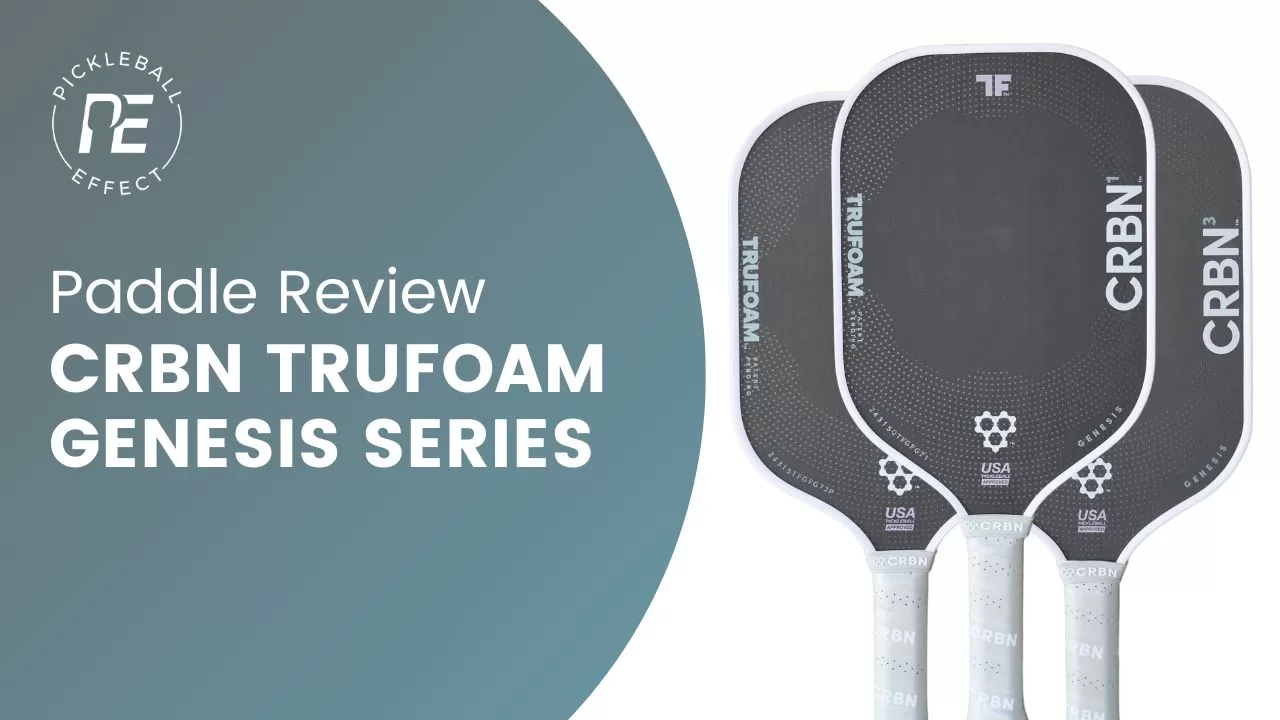
CRBN’s TruFoam Genesis series features a full foam core and comes in three shapes. This review will dive into the advantages of foam cores, the technology behind their TruFoam core, the overall performance of the series, and then finish with a brief review of each shape and their nuances.
If you find my review helpful and decide to purchase one of these paddles, please use my code PBEFFECT on CRBN’s website. This will give you a discount and support my review efforts. Thanks to CRBN for sending me these paddles; however, this article is not sponsored, and all opinions are my own.
Looking for the right paddle to fit your game? Take our paddle fitting quiz for three recommendations that will match your style of play.
The impact feel of the CRBN TruFoam paddles is unique. It’s softer and more comfortable than the plastic-on-plastic feel of a polymer core, but it’s not overly plush and still has a crisp response.
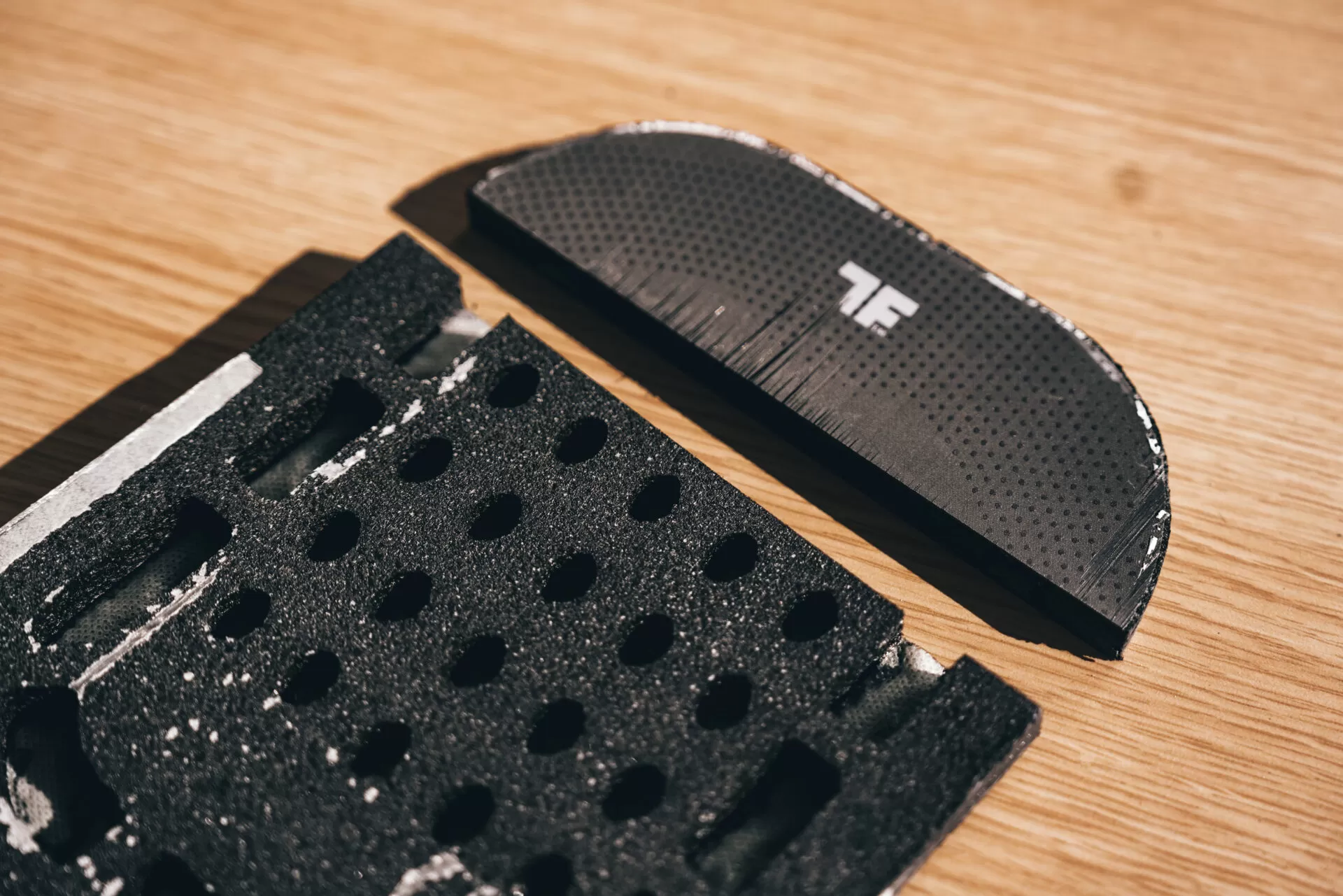
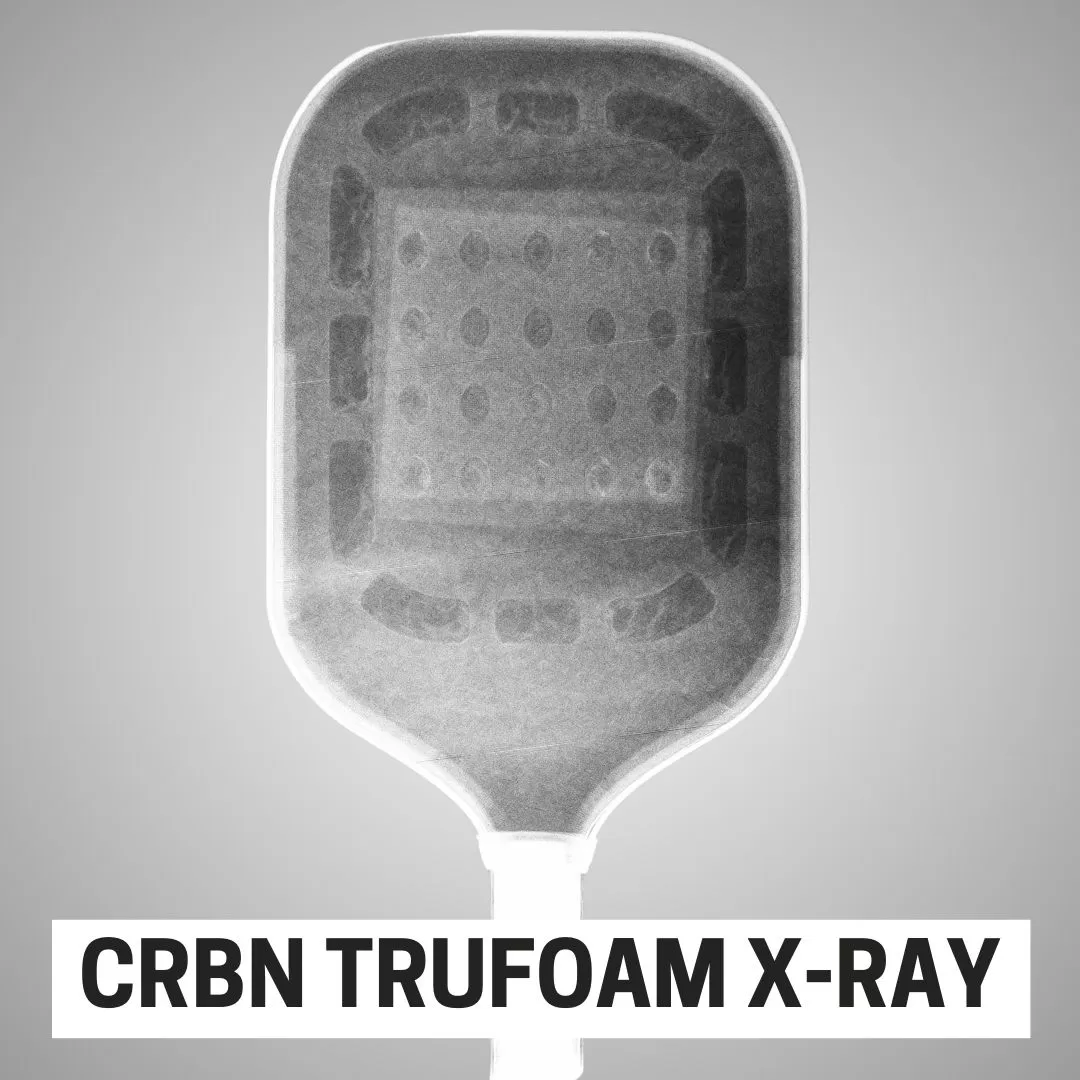
The large white square covering the circular voids in the x-ray is a fiberglass layer that’s next to the foam core which adds pop and power to bigger swings. On top of the fiberglass layer are carbon facing layers. You’ll also see more white around the bottom half of the paddle’s edges in the x-ray. That’s another fiberglass layer attached to the edge of the foam, providing targeted perimeter weighting for enhanced stability and balance.
(Get 10% off with the discount code PBEFFECT on CRBN’s website)
While the above section was meant to give you the general idea of the TruFoam Genesis series as a whole, this section will give you a more detailed look into the nuances and numbers of each paddle in the series.
The series is offered in four different shapes. The TFG1, TFG2, TFG3 and TFG4. The TFG1 and TFG3 are both elongated but with different handle lengths. The TFG1 has an extended handle length of 5.5” while the TFG3 has a 5.25” handle length. Then the TFG2 is a widebody shape with a 5.25” handle and the TFG four is a hybrid with a 5.5″ handle.
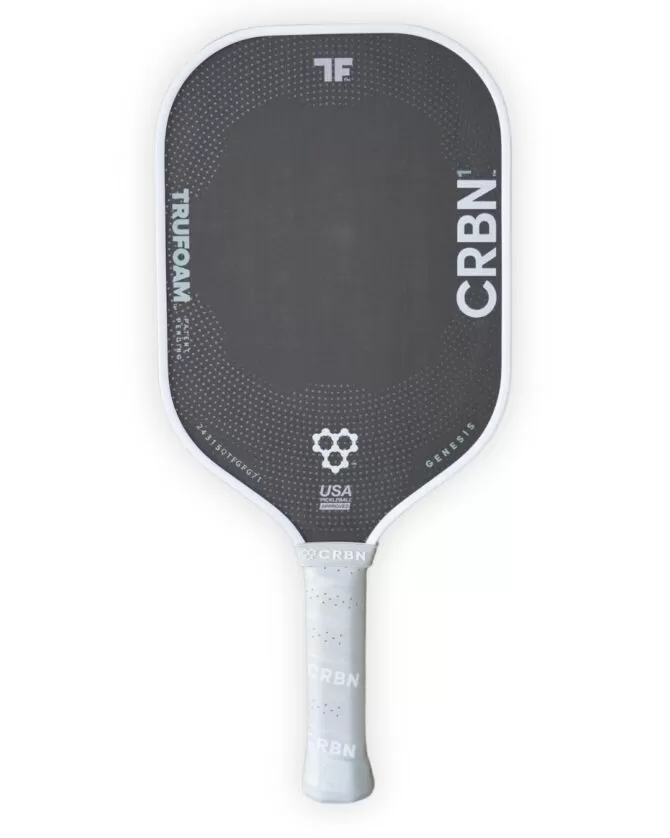
Of the two elongated shapes CRBN offers, this one has a lighter swing weight. So if weight is a concern and you want an elongated shape, this is the one for you. Although it is lighter than the TF3, it’s not as forgiving out of the box as the TF3.
Both of the elongated shapes offered more power and a little less pop than the TF2. This actually made them a little easier to control at the net than the TF2, but put less pressure on counters.
Although I liked the feel and playability of the elongated shapes, I wished the sweet spots were bigger. As a result, I preferred them modified rather than stock.
To improve the sweet spot while also keeping the weight under control, I added three grams of tungsten tape to each of the bottom corners and then replaced the butt cap with a one-ounce Slyce cap.
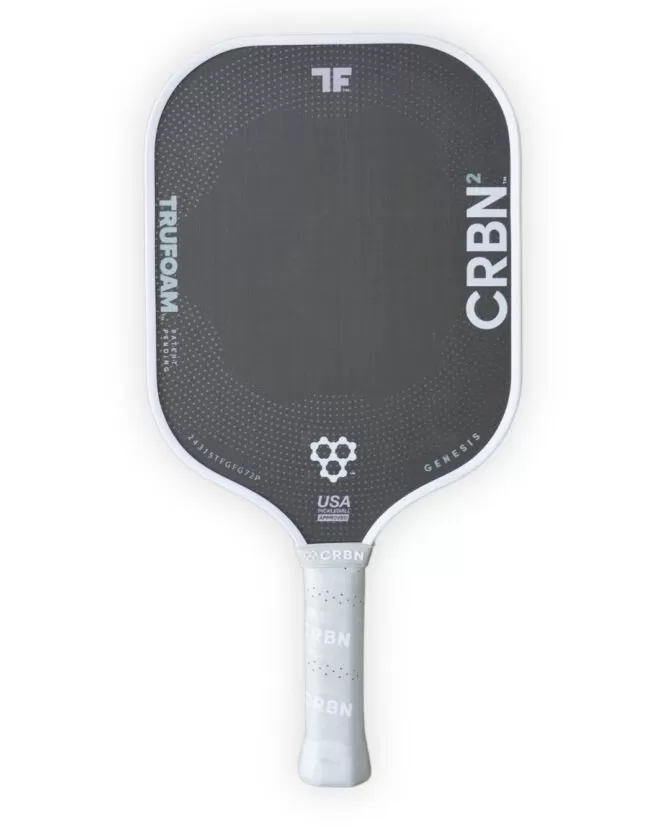
Of the three shapes, this one was my favorite. It was the most forgiving and easiest to maneuver. Its average swingweight of 112 is slightly higher than most 14mm paddles, which I appreciated. Many 14mm widebody shapes like this one are too light and lack the plowthrough to carry through the ball; this one did not. The added weight also improved its stock forgiveness compared to other 14mm widebody paddles.
The TF2 has a slightly different profile than the elongated shapes: it offers less power from the baseline but more pop at the net. I favored the combination of extra pop and maneuverability at the net over the elongated shapes. I felt more offensively effective at the net with the TF2 despite sacrificing some reach.
While this paddle plays well stock, I modified it to suit my preferences. In order to gain a bit more power and stability, I experimented with weight in the throat, trying a couple of different tungsten tape densities. I ended up putting three and a half grams of 1g per inch tungsten on the side that covers the crbn logo. I also added a 6g of tungsten tape near the butt cup to improve hand speed and enhance the paddle’s overall solidity. With these modifications, my swingweight increased from 112 to 116, my twistweight changed from 6.7 to 7.4, and my balance point dropped from 238 to 232.
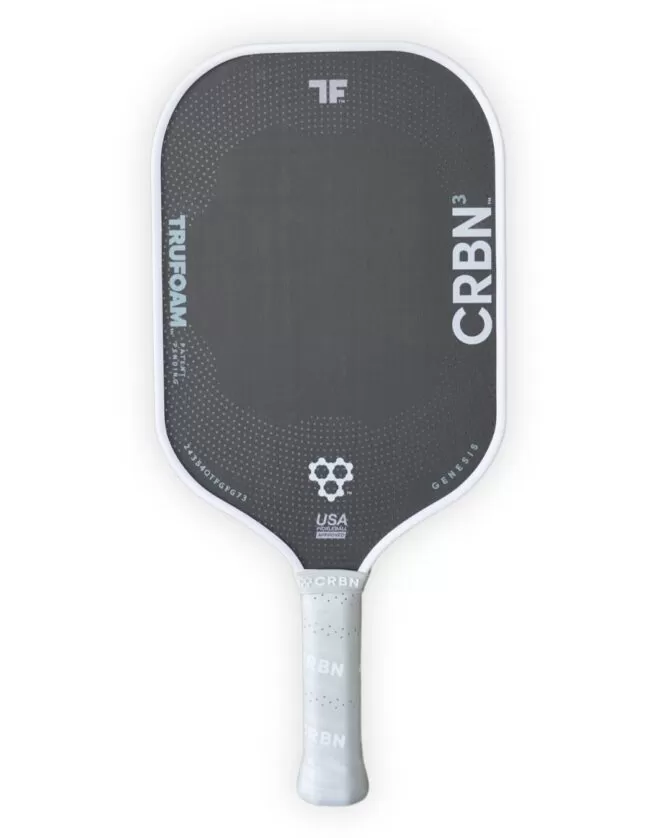
Not many brands offer two different handle lengths for their elongated options so it’s nice to have options there. This is their elongated option with a medium length handle of 5.25”. Shortening the handle added more material to the face which improved its stability and forgiveness over the TF1 but also made it heavier with an average swingweight of 121.
Like the TF1, it has a higher power and lower pop profile compared to the TF2 and largely plays the same as the TF1 other than the different weight.
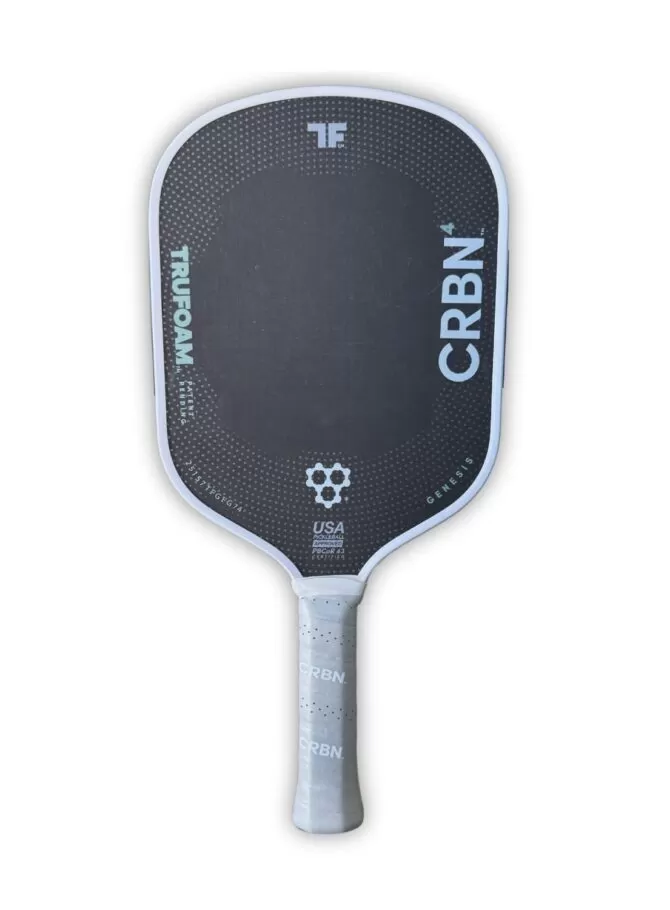
This shape option was introduced six months after the original TFG launch and is a welcome addition to the series. To me, the TFG4 and TFG2 are the best options.
It fills in the gap of a longer option with a lighter swingweight. Not only is it lighter than the 1 and 3 but it’s even on the lighter end of hybrid shaped paddles. It’s very maneuverable but still has the TruFoam feel that I love. Its sweet spot is a little below average for a hybrid but because it came in lighter it’s easy to customize with some tungsten tape (unlike the elongated options). You can always add weight but you can’t take it off.
I added four grams of weight directly on the sides which boosted the twistweight close to 7, swingweight to 114, and the static weight to 8.4 oz. This gave it the plowthrough and stabilty boost I wanted from it and it’s swingweight was still on par with the average hybrid paddle.
If you’re a fan of CRBN paddles and have been using their Power X series you may be wondering how these compare. There are several thickness options of the X series so I’ll just compare them to the 16mm versions to keep things simple.
With the TruFoam Genesis you get an offensive boost in both power and pop, similar maneuverability, more spin, and improved feel. Control wise the X series absorbs more pace for you though overtime as I adjusted to the TruFoams I don’t think I was controlling the X series any better. However, if you don’t have a well developed soft game then you would be able to control the X series better.
I really like what CRBN did here with the foam paddles and think this is a peek into the future of paddle core technology. While there may not be some huge performance gains with this new tech I do think they play marginally better compared to past generation aggressive all-court style paddles and the durability gains in the core is a big deal. I’d love to see more brands innovating around durability like this.
After doing this review I decided to keep the TF2 in my bag and will use it as my main paddle for now. I personally loved the intuitive feel it has and think it offers enough offense to be dangerous while keeping my creative shot making abilities in tact.
We’ve categorized paddles into three categories. Control, All-Court, and Power. Paddle categories are determined by Braydon after he hits or reviews the paddle.
A paddle’s weight represents the inherent mass of the paddle as measured on a scale. However, relying solely on this static weight measurement can be misleading when assessing the true perceived heaviness of the paddle. Even if two paddles both clock in at 8 oz, their actual heft in your hand can markedly differ due to variations in weight distribution within the paddle. This is why the static weight should be considered with the swingweight of the paddle. See the definition of swingweight below.
The weight value listed in the database corresponds to the paddle’s weight that I used to gather the swingweight and twistweight measurement. It’s possible that if your paddle has a different static weight than then the swingweight and twistweight may be slightly different.
Swingweight is a measure of the paddle’s resistance to swinging about the end of the handle. The higher the swingweight number the heavier it will feel in your hands. A higher swingweight has more power but is harder to swing, lower swingweight is easier to swing but has less power. Sometimes a faster swing with a lower swingweight can make up for power lost in swingweight. The price paid for that is greater impact shock. Stock swingweights will vary between 100 – 140.
Twistweight is the resistance to rotating around the long axis through the middle of the paddle from butt to tip. The higher the twistweight the more resistance the paddle has to rotating on off center hits. This measurement is closely related to the amount of forgiveness or the size of the sweet spot of the paddle. A higher twistweight indicates a bigger sweet spot. Twistweight numbers range from 5 – 8.
Measuring the revolutions per minute (RPMs) off of a serve you get a number that shows the spin potential of a paddle. Using these RPM measurements I’ve created five buckets that a paddle will fall into indicating its overall spin potential. The five buckets are:
1900 or Higher = Very High
1700 – 1900 = High
1500 – 1700 = Medium
1300 – 1500 = Low
1300 or less = Very Low
You can tell a big difference in the amount of spin a paddle generates when you compare a Very High paddle to a low paddle. But the gains from Medium to High to Very High are marginal. We’ve found that having at least a medium rating is often enough if you’re looking for a good spin paddle. However, if you’re a big hitter then you will benefit more from a high spin paddle to help you keep the ball in play more often.
The power level of a paddle is shown in miles per hour (MPH) after taking ten measurements with a speed gun of hitting a serve as hard as I can. This measurement gives you an idea of how hard you can hit the ball when given the chance to take a full swing. So shots like serves, drives and overheads. The higher the MPH reading the more power you can generate with the paddle.
I also show the percentile ranking of the measurement to give you an idea of how it stacks up against the rest of the paddles in my database.
The pop level of a paddle is shown in miles per hour (MPH) after taking the average of ten speed gun measurements of hitting a punch volley as hard as I can. This measurement gives you an idea of how hard you can hit the ball on shorter swings and gives you an idea of how quickly a ball comes off the face when you apply less force on the ball. So shots volleys, dinks, counters, and resets are all affected by the pop measurement. The higher the pop measurement the stronger your counters will be but it takes more skill to keep the ball from floating or popping up on you when resetting a hard hit ball or when dinking.
I also show the percentile ranking of the measurement to give you an idea of how it stacks up against the rest of the paddles in my database.
The term “forgiveness” pertains to both the size of the sweet spot and the stability of the paddle. A paddle that is more forgiving offers a larger sweet spot, greater stability, and yields more power when hitting off-center shots. On the other hand, a less forgiving paddle has a smaller sweet spot and does not provide as much power when hitting off-center shots.
While there seems to be only benefits of more forgiving paddles, less forgiving paddles are often more maneuverable and is easier to generate more paddle speed.

Looking for the right paddle to fit your game? Take our paddle fitting quiz for three recommendations that will match your style of play.