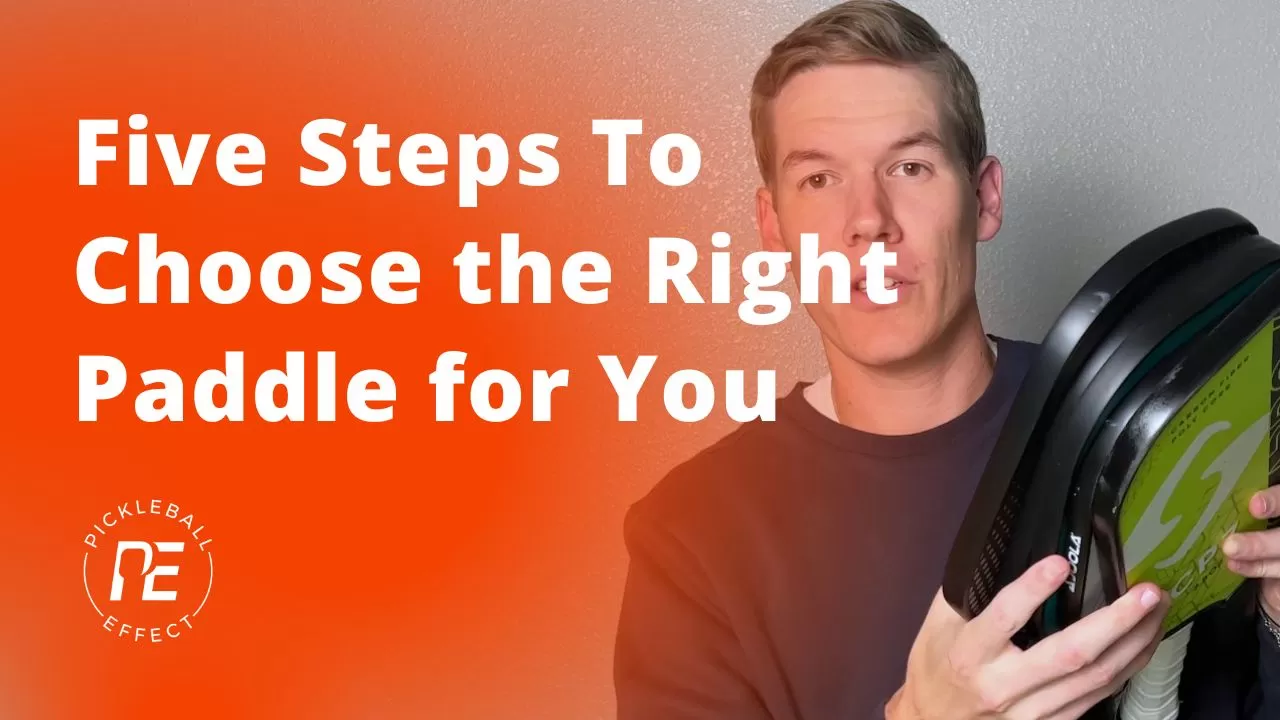
To play your best pickleball, it’s crucial to select a paddle that aligns with your playstyle, amplifies your strengths, and minimizes your weaknesses. But it’s hard to find that paddle with so many different options and every brand claiming their paddles are perfect for everyone which simply isn’t true. The best way to cut through the marketing noise and pick the best paddle for you is to identify what you need and learn how to match the corresponding paddle specs and data to what you need. Which is exactly what I’m going to show you how to do.
In this guide, I will walk you through five practical steps on how to choose the best pickleball paddle for you and explain how to use my paddle database to narrow down your options based on your takeaways from these steps.
This is a system I’ve developed over the years as I’ve done paddle reviews and have fitted hundreds of players to a paddle. It works. Let’s get started.
Looking for the right paddle to fit your game? Take our paddle fitting quiz for three recommendations that will match your style of play.
There are many factors that determine whether a paddle is classified as a control, power, or all-court paddle, which we won’t delve into. You just need to decide which style of paddle suits you best.
I recommend a control type paddle if you’re newer to the game or if you need help keeping the ball down and controlling placement. Mastering soft shots like drops, resets, and dinks is often the most challenging part of the game, and a control paddle makes executing those shots easier. Many professional players also opt for control type paddles so if you’re an advanced player that can generate your own power then you may still benefit from the extra forgiveness and consistency of a control paddle.
For those with an already developed soft game or those who need assistance in generating power to finish points, I recommend an all-court type paddle. All-court paddles are popular at all levels of play as they offer offensive capabilities without sacrificing too much control and forgiveness. If you’re unsure about which paddle type to choose, an all-court paddle is a safe option.
I recommend power type paddles less frequently, although they certainly have their place. If you have an aggressive playing style and enjoy driving the ball and attacking whenever possible, a power paddle is a good choice for you. A good power paddle provides extra power and speed, giving you the advantage when attacking and finishing points. However, they can be more challenging to control and usually have smaller sweet spots.
We’ve partnered with Pickleball Central to give you up to 10% off paddles, shoes and gear. Some Exclusions apply.
Click link below to apply discount sitewide.
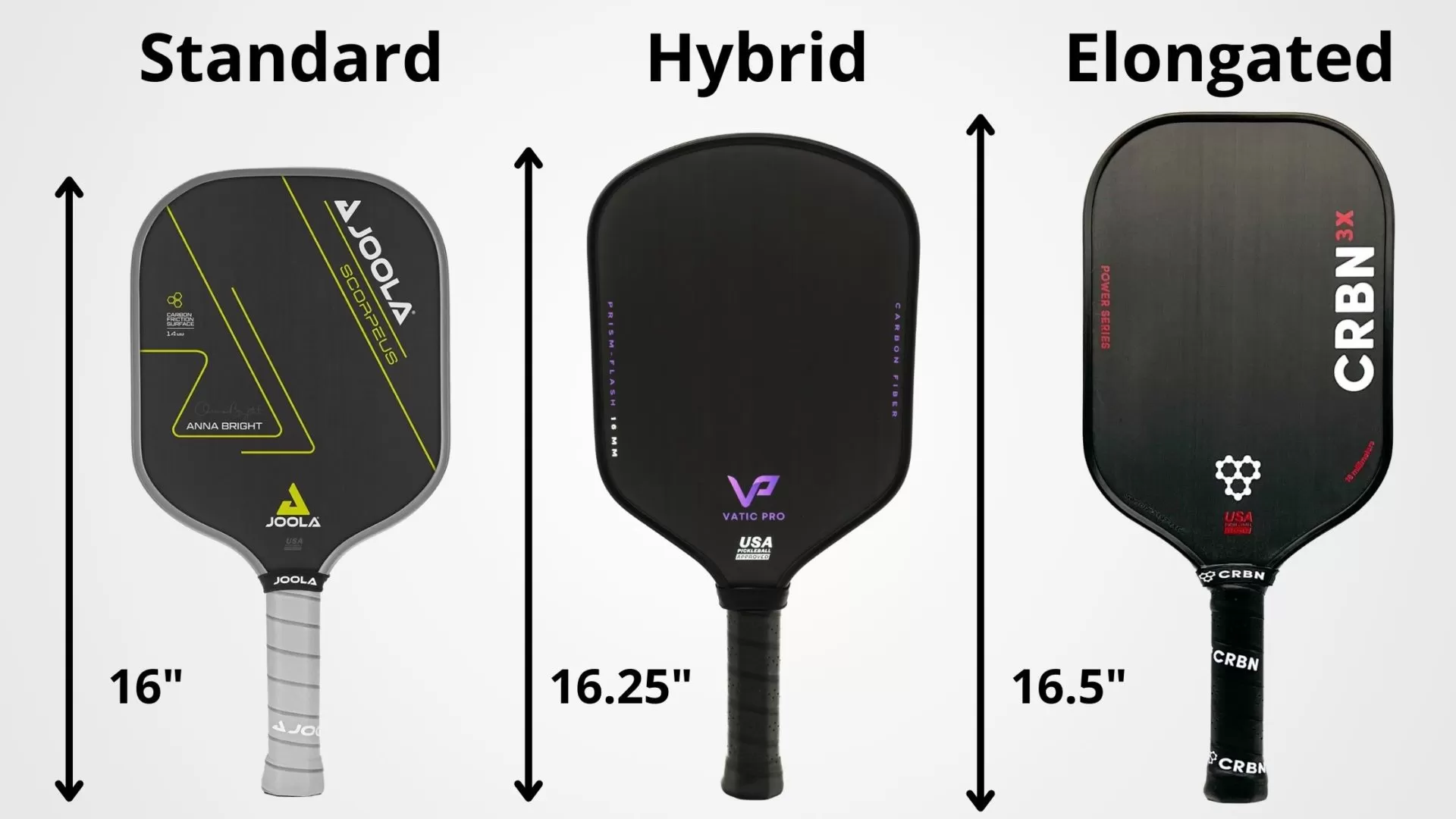
Paddle shape dimensions:
Characteristics of each paddle shape:

Swingweight: Swingweight measures a paddle’s resistance to swinging around the handle. A higher swingweight feels heavier but has more power, while lower swingweight is easier to swing but has less power. Don’t confuse swingweight with a paddle’s static weight; two paddles can weigh the same but one may feel heavier than the other when you swing because it has a higher swingweight. Stock swingweight measurements are between 100-130.
I recommend aiming for the highest swingweight you can comfortably handle, as it generally leads to improved stability, control, and power to effectively hit winning shots. For most players, a swingweight around 115 strikes the ideal balance between maneuverability and stability. It also helps if you can see what the swingweight of your current paddle is from the paddle database below so you can use that as a reference for what you like.
When it comes to twistweight, higher values are generally preferred by the majority of players. However, opting for a lower twistweight enhances maneuverability, particularly if you prioritize a fast-paced playing style. In such cases, combining a lower twistweight with a lower swingweight will provide the desired agility.
Welcome to the final step, where the magic happens. The information I’ve provided above regarding paddle measurements and characteristics is not often available straight from manufacturers. However, I have taken the time to gather and input this data into a paddle database I have created. All the statistics shown in the paddle database are personally collected and each paddle’s type is determined after thorough playtesting and reviews.
Now, you can take the information you selected from the above five steps and utilize it to filter the database below. This will provide you with a tailored selection of paddles that perfectly match your playstyle and meet your specific requirements.
For example, say you wanted a control paddle, standard shape, handle length >= 5 inches, a lighter swingweight <115, and a good twistweight >6. You can input that information in the paddle database filters to narrow down the list of paddles that match the criteria. Or, you can just look over the stats for paddles you’re interested in and see where they fit. You can scroll down and sideways on the table and links to the paddles are provided on the far right of the table.
IMPORTANT NOTE: The database filters will only work if you’re on a desktop computer. If you’re on a mobile device then you’ll have to do this step when you are on a desktop computer.
We’ve categorized paddles into three categories. Control, All-Court, and Power.
A paddle’s weight represents the inherent mass of the paddle as measured on a scale. However, relying solely on this static weight measurement can be misleading when assessing the true perceived heaviness of the paddle. Even if two paddles both clock in at 8 oz, their actual heft in your hand can markedly differ due to variations in weight distribution within the paddle. This is why the static weight should be considered with the swingweight of the paddle. See the definition of swingweight below.
The weight value listed in the database corresponds to the paddle’s weight that I used to gather the swingweight and twistweight measurement. It’s possible that if your paddle has a different static weight than then the swingweight and twistweight may be slightly different.
Swingweight is a measure of the paddle’s resistance to swinging about the end of the handle. The higher the swingweight number the heavier it will feel in your hands. A higher swingweight has more power but is harder to swing, lower swingweight is easier to swing but has less power. Sometimes a faster swing with a lower swingweight can make up for power lost in swingweight. The price paid for that is greater impact shock. Stock swingweights will vary between 100 – 140.
Twistweight is the resistance to rotating around the long axis through the middle of the paddle from butt to tip. The higher the twistweight the more resistance the paddle has to rotating on off center hits. This measurement is closely related to the amount of forgiveness or the size of the sweet spot of the paddle. A higher twistweight indicates a bigger sweet spot. Twistweight numbers range from 5 – 8.
Measuring the revolutions per minute (RPMs) off of a serve you get a number that shows the spin potential of a paddle. Using these RPM measurements I’ve created five buckets that a paddle will fall into indicating its overall spin potential. The five buckets are:
1900 or Higher = Very High
1700 – 1900 = High
1500 – 1700 = Medium
1300 – 1500 = Low
1300 or less = Very Low
You can tell a big difference in the amount of spin a paddle generates when you compare a Very High paddle to a low paddle. But the gains from Medium to High to Very High are marginal. We’ve found that having at least a medium rating is often enough if you’re looking for a good spin paddle. However, if you’re a big hitter then you will benefit more from a high spin paddle to help you keep the ball in play more often.
Looking for the right paddle to fit your game? Take our paddle fitting quiz for three recommendations that will match your style of play.