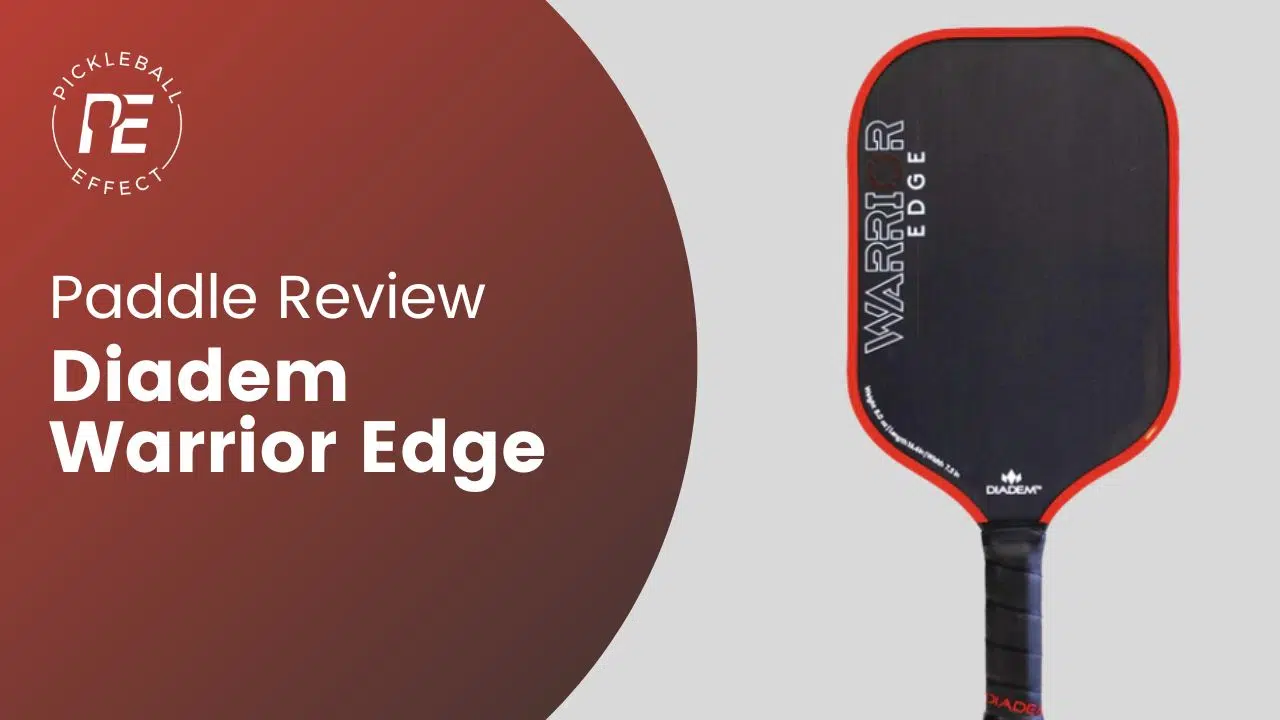
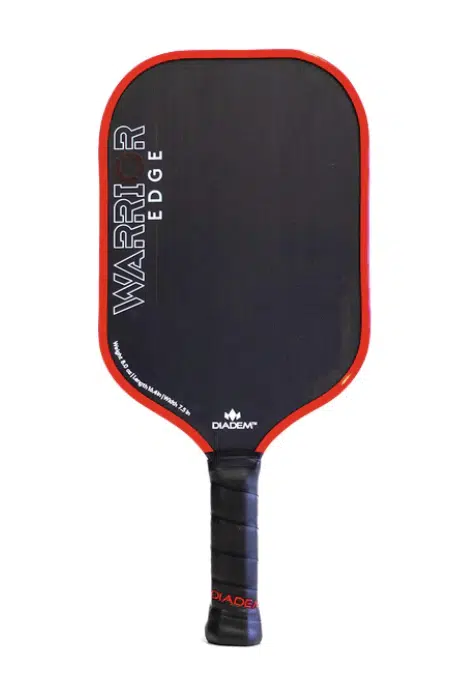
The majority of the most popular paddles on the market all use a raw carbon fiber facing material. The material is primarily well liked because of its high spin potential. Diadem has obviously noticed and wanted to join the party. Their new Warrior Edge has a raw carbon fiber face and does in fact have a similar high spin rating compared to all the other paddles that use it too. There are some characteristics about it, though, that make it play a little differently than the other paddles in its cohort. I talk about those in the Shape & Design section below.
The Warrior Edge follows Diadem’s last performance paddle, the Warrior. It’s not meant to replace the original Warrior, but adds to Diadem’s growing catalog of paddles.
After drilling and playing with the paddle for over two weeks, here’s my review of its performance.
Looking for the right paddle to fit your game? Take our paddle fitting quiz for three recommendations that will match your style of play.
I’m categorizing this one as an all-court paddle. The paddle had a crisp, light, and semi hard feeling to it and was semi poppy out of the box. But after a week of drilling and playing with it nearly everyday it broke in a bit and that semi-hard feeling went away and was replaced with a more soft, plush feel.
You notice real quick that it has a high spin rating and joins the ranks of the many other raw carbon fiber paddles that also have higher spin ratings. You can see the ball dip a little more on your serves, drives, and rolls at the net. It’s a nice asset to have.
When it came to attacking, I was surprised how much power it had. It wasn’t a power paddle but it did have more pop than their original Warrior and enough to put in the all-court category. It’s a midweight paddle at about 8 oz but it is well balanced and moves easily in your hands. I never felt behind the ball in hands battles and it was easy to accelerate through the ball with any stroke. It was a good combination of spin, speed, and decent pop that enabled offense well.
Talking about the soft game. I liked the feel of it when you hit the ball but wasn’t 100% in tune with it. I never knew for sure if I hit it well or if I popped it up a little. My soft game didn’t take a big hit and it still performed well there in most cases. Routine dinks, drops from the midcourt and blocks all performed well but my drops from the baseline weren’t quite the same. I kept floating those more than normal during the entire two weeks I played with it. This might be the first paddle I’ve played where I could take pace off the ball well with blocks, but didn’t have that same touch with my thirds. I think if I kept playing with the paddle I’d get my thirds to behave like I wanted but it didn’t come to me in the two weeks I played with it.
The bottom line: The Warrior Edge has a nice combo of spin, speed, and decent pop that improves your attacking ability. It has a nice feel that is controllable in most cases but I was less consistent with drops from the baseline.
The Warrior Edge has a traditional elongated shape that’s 16.5” long and 7.5” wide to give you some extra reach and moves the sweet spot up on the face. Diadem went with a 5” long handle though I would have liked to see them make that at least 5.25” or even a little longer than that. The bottom of elongated paddles are pretty dead and I think there are more benefits to a longer handle than leaving that dead space there.
It has a 16 mm core and is 8 oz in weight. This is thinner and lighter than their original Warrior which was 19 mm thick and 8.5 oz. The biggest drawback to the original Warrior was its heavier weight so they addressed that with the Edge.
Diadem also introduced what they are calling their Aero Guard. It’s essentially a couple of grooves built into the edge guard and it’s supposed to help with aero dynamics though I doubt it really does much.
Finally, they are using a raw carbon fiber face that was made popular by Electrum and is also used in CRBN, Engage, Joola, and a few other smaller brands. It’s a great facing material that adds plenty of spin and lasts longer than spray on type grit surfaces.
The soft game was a bit polarizing for me with the Edge. I enjoyed the feel of it and could execute routine dinks, blocks, and drops from the midcourt well but for some reason I never felt connected with my thirds or defense from the baseline in general. The ball jumps off the face pretty quick which takes away some feel from the paddle and makes those shots less consistent for me. I’m not saying that I could never hit a third well, but I never felt like myself with those shots during the entire two weeks I played with it.
Interestingly, I felt comfortable with it nearly everywhere else on the court. This may be the first paddle I’ve played that felt good when taking pace off the ball with blocks and resets but didn’t have that touch with my thirds.

I think this is a good all around paddle but I didn’t feel like there was anything that significantly differentiated it from other raw carbon fiber paddles I’ve played. It’s priced within $10 of the CRBN and Electrum and $40 cheaper than the Joola Hyperion CFS 16. If you know you want a raw carbon fiber faced paddle then picking what to get may come down to small things like the grip size, weight and looks when deciding which one you want. Fortunately for Diadem, the looks of this paddle are clean so they have that going!
The Edge has a nice combo of spin, speed, and pop that improves your attacking ability. It has a nice feel that is controllable in most cases but I never felt completely in tune with my thirds. If you’re looking for a good all-court paddle that has a high spin rating and is maneuverable then this should be an option you consider. However, if you are looking for something similar but offers a bit more control then I’d look at Diadem’s original Warrior paddle or the Electrum Model E.
Looking for the right paddle to fit your game? Take our paddle fitting quiz for three recommendations that will match your style of play.