
Compare pickleball paddles like never before! More filters, more data, all in an easy to use interface.
Built for serious players who want more than marketing claims. This database gives you access to original paddle specs and performance data collected entirely in-house by Braydon. Compare swing weight, twist weight, balance point, power, pop, spin, and more to quickly filter and find the best paddle for your game.
The database can be filtered and sorted on desktop but not on mobile. If you’re on a desktop then click on the “Filter” option in the top bar of the table and then select “Add condition” to pick which column you’d like to apply filter criteria. You can also sort the database by clicking on any column.
*All data on this website is proprietary intellectual property of Pickleball Effect. Personal research use only. Unauthorized scraping, reproduction, redistribution, or commercial use is strictly prohibited. See Terms of Service.
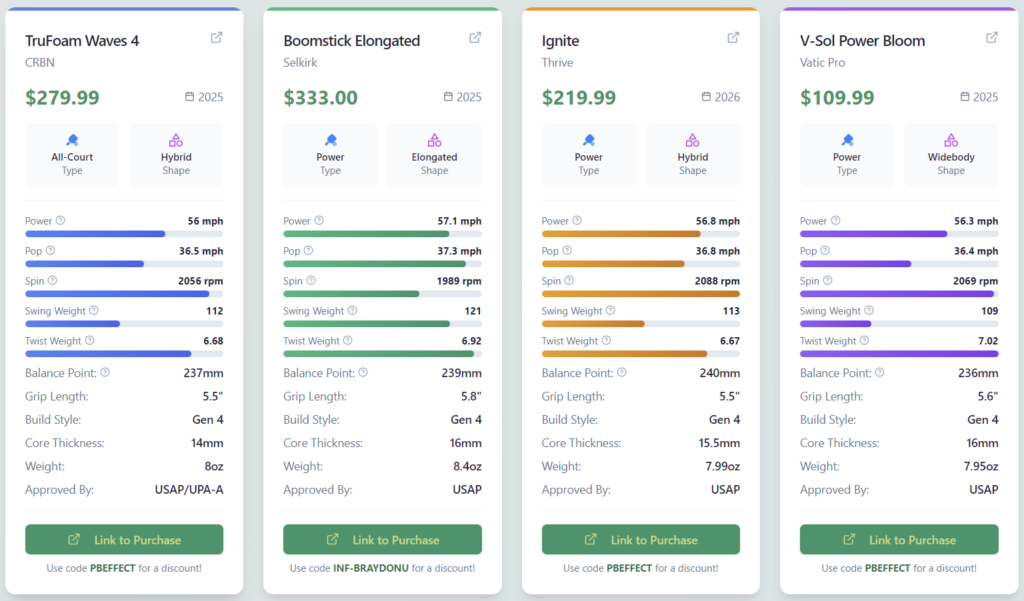
Stack up multiple paddles side by side and visually compare specs & performance data in one place. Use built-in filters and tools to quickly find the right fit for your next paddle.
If you like spreadsheets then here’s the same data in Google Sheets that you can view and/or make a copy of so you can do any sort of analysis that suits you.
All paddle measurements in this database are collected in-house and are not sourced from manufacturers or third parties. The database is updated as new paddles are tested, typically every one to two weeks.
While power, pop, and spin testing involve human execution rather than robotic automation, testing conditions and methodology are kept consistent to ensure the best comparisons we can.
Paddles are categorized into three types: Control, All-Court, and Power.
Classification is determined by Braydon after on-court testing and review, based primarily on the paddle’s offensive output and its ability to absorb or return pace.
Control – Lower offensive output with stronger pace absorption. Designed to help reduce incoming speed and improve consistency in resets, drops, and soft exchanges.
All-Court – Balanced offensive output and pace absorption. Offers versatility without strongly favoring either extreme.
Power – Higher offensive output with greater energy return. Designed to generate more speed on serves, drives, and counters, but absorbs less incoming pace.
Weight represents the paddle’s static mass as measured on a scale.
Static weight alone does not fully describe how heavy a paddle feels in play. Two paddles with the same listed weight can feel very different due to differences in weight distribution. For this reason, weight should always be considered alongside swing weight, which better reflects perceived heaviness during a swing.
The weight listed in the database corresponds to the specific paddle used to measure swing weight and twist weight. If your paddle’s static weight differs from the listed value, its swing weight and twist weight may vary slightly as well.
Paddle shape is defined by overall length and width. There are three primary shapes:
Elongated – 16.5″ x 7.5″
Widebody – 16″ x 8″ or shorter/wider
Hybrid – Approximately 16.25″ x 7.5″–7.7″
Shape Characteristics
Elongated – Greater reach and typically higher power and spin potential, but less side-to-side forgiveness.
Widebody – Shorter reach with generally greater forgiveness and stability across the face.
Hybrid – A middle ground that blends added reach with improved forgiveness.
Advanced players often prefer elongated shapes for offensive upside, while developing players tend to benefit from the added forgiveness of widebody or hybrid shapes.
Ultimately, paddle shape should match your playing style, strengths, and priorities. Whether that’s maximizing reach or improving forgiveness.
New paddle technologies have been introduced overtime. The construction of a paddle can indicate some of its play characteristics. However, like the other factors mentioned in the database, it doesn’t always provide a complete picture and is just one contributing factor.
You’ll see reviewers and brands refer to these different construction methods as generations (e.g., Gen 1, Gen 2), since they were adopted in that order. However, a newer construction method isn’t necessarily superior to an older one.
Cold Pressed (Gen 1): In the cold pressing construction method, the paddle’s facing layers are adhered to the polymer core, and then an edge guard is wrapped around it. While this construction is often recognized for producing a plush feel and control-oriented paddle, this is not always the outcome.
Light Thermoforming (Gen 1.5): Introduced in 2023. This unique category encompasses paddles constructed similarly to Gen 1, cold-pressed paddles, but with the added feature of expanding foam injected around the perimeter. The foam is contained by a layer of carbon fiber, which is then heated and pressurized slightly to expand the foam before an edge guard is applied. These paddles are also recognized for their control style.
Full Thermoforming (Gen 2): Introduced in 2023. Thermoformed paddles are made by applying heat to fuse the facing layers and a carbon fiber perimeter. They often have foam injected around the edges and are known for power and stability, usually falling into the all-court category. This style is similar to Gen 1.5, except it undergoes additional heat and pressure to create a more rigid carbon edge, which further stiffens the paddle.
Widened Foam Edge (Gen 3): Introduced in 2024. Paddles in this category, similar to Gen 2 paddles, utilize thermoforming but incorporate additional foam around the perimeter, creating a dual foam wall. Popularized by JOOLA, this method can vary by adjusting the type and amount of foam used around the perimeter. While generally categorized as power paddles due to their increased power, this is not always the case.
Full Foam Core (Gen 4): Introduced in 2025. Paddles in this category utilize a full foam core, a departure from the polypropylene cores used in previous generations. Popularized by CRBN, this method can produce a variety of paddle types and is known for enhancing feel and durability compared to polypropylene cores. As this technology is still new to the industry, it continues to be evaluated and developed.
Swingweight is a measure of the paddle’s resistance to swinging about the end of the handle. The higher the swingweight number the heavier it will feel in your hands. A higher swingweight has more power but is harder to swing, lower swingweight is easier to swing but has less power. Sometimes a faster swing with a lower swingweight can make up for power lost in swingweight. The price paid for that is greater impact shock. Stock swingweights will vary between 100 – 140.
Twistweight is the resistance to rotating around the long axis through the middle of the paddle from butt to tip. The higher the twistweight the more resistance the paddle has to rotating on off center hits. This measurement is closely related to the amount of forgiveness or the size of the sweet spot of the paddle. A higher twistweight indicates a bigger sweet spot. Twistweight numbers range from 5 – 8.
Balance point is the distance of the paddles center of gravity from the butt of the handle. The bigger the number the further the balance point is from the butt of the handle. Paddles with higher balance points will carry through the ball better but aren’t as easy to maneuver because the weight of the paddle is further way from your hand. Paddles with smaller balance points are easier to maneuver and often easier to control.
Measuring the revolutions per minute (RPMs) off of a serve you get a number that shows the spin potential of a paddle. Using these RPM measurements I’ve created five buckets that a paddle will fall into indicating its overall spin potential. The five buckets are:
1950 or Higher = Very High
1900-1950 = High
1850-1899 = Medium
1849 or less = Low
You can tell a big difference in the amount of spin a paddle generates when you compare a Very High paddle to a low paddle. But the gains from Medium to High to Very High are marginal. We’ve found that having at least a medium rating is often enough if you’re looking for a good spin paddle. However, if you’re a big hitter then you will benefit more from a high spin paddle to help you keep the ball in play more often.
Power is measured in miles per hour (MPH) and represents the average of ten maximum-effort serves recorded with a speed gun.
It reflects how fast the ball can travel when taking a full swing, influencing serves, drives, and overheads. Higher MPH readings indicate greater top-end power potential.
A percentile ranking is also shown to indicate how the paddle’s power compares to the rest of the database.
Pop is measured in miles per hour (MPH) and represents the average of ten speed gun readings from maximum-effort punch volleys.
It reflects how quickly the ball comes off the paddle face on shorter, compact swings. Pop influences volleys, counters, dinks, and resets.
Higher pop generally produces stronger, faster counters, but it requires more precision to control touch shots and prevent the ball from floating or popping up during resets and soft exchanges.
I also show the percentile ranking of the measurement to give you an idea of how it stacks up against the rest of the paddles in my database.
Firepower is a composite offensive metric that combines a paddle’s standardized Power and Pop measurements to represent overall offensive ability.
Firepower Percentile shows how that offensive output ranks compared to every other paddle tested.
It represents the percentage of paddles that a given paddle scores higher than in overall Firepower.
For example:
• 90th percentile = More offensive than 90% of paddles tested
• 50th percentile = Database average
• 10th percentile = More offensive than 10% of paddles
Unlike the 0–100 Firepower Score, which reflects standardized magnitude, Firepower Percentile reflects rank position within the dataset.
Because it is distribution-based, the percentile automatically updates as new paddles are added.
Firepower Z Scale (0–100)
Firepower Z represents a paddle’s overall offensive ability relative to the rest of the paddles in the database.
It combines two measured performance variables:
• Power
• Pop
Step 1: Standardization (Z Score)
Each paddle’s Power and Pop are first converted into Z scores, which measure how far above or below the database average the paddle performs.
Power Z = (Paddle Power − Database Mean Power) ÷ Standard Deviation
Pop Z = (Paddle Pop − Database Mean Pop) ÷ Standard Deviation
Firepower Z = (Power Z + Pop Z) ÷ 2
This creates a standardized offensive score that reflects performance relative to the full dataset.
Step 2: Conversion to 0–100 Scale
To make the metric easier to interpret, the Firepower Z Score is converted to a 0–100 scale.
On this scale:
• 50 = Database average
• Above 50 = Above-average offensive output
• Below 50 = Below-average offensive output
The 0–100 scale preserves relative differences while making the number more intuitive for comparison.
Firepower Tiers
Paddles are grouped into tiers based on their relative position within the full database distribution.
• Elite Firepower – Top ~10% of paddles
• High Firepower – Next ~20%
• Balanced Firepower – Middle ~40%
• Controlled Firepower – Next ~20%
• Low Firepower – Bottom ~10%
These tiers dynamically update as new paddles are added to the database.
Why This Matters
Firepower Z reflects how offensively potent a paddle is compared to everything else tested under the same measurement system. Because it is standardized against the full dataset, it allows meaningful apples-to-apples comparison across brands, shapes, constructions, and core technologies.